Success Together

24 02 2011

Many readers of this blog will know that I am a fan of Hildy Gottlieb’s work  (Creating The Future) and I apply a number of her concepts and principles in my practice (thanks Hildy, you spread the love so generously). One of the things I’ve been thinking about lately is a topic Hildy has ranted about many times, and a fundamental question Hildy is always asking: what will it take for the community benefit sector to achieve genuine success (or, the flip side, what’s stopping that from happening?):

Success in the Community Benefit arena doesn’t come from being the smartest and the fastest and the best. Yes, you may become the best funded organization. But success in the Community Benefit world is about – well – Community Benefit! And none of us can do that on our own. It is clear that this sector’s potential can only be reached if we link arms together to create the healthy, vibrant communities we all want. To accomplish that, many of the systems we rely upon in this sector will need to shift, from competitive systems that keep us apart to systems that encourage and nurture interconnectedness and interdependence. [Hildy Gottlieb]

Amen to that.

So, I’ve been thinking about that shift and how to support it. I’m wondering about the figurative linking of arms and how that might tangibly or literally be accomplished in a typical community. There are no shortage of inspiring examples on a global scale (just in these past weeks the Middle East is full of them). Examples can also be found within the ranks of the collective impact movement (see: http://www.ssireview.org/articles/entry/collective_impact/). So what about here, within Hamilton neighbourhoods? How do small community efforts grow to become community benefit successes? That’s been occupying my mind of late, and steering me to seek out viable answers. It seems vital that our local community benefit organizations be encouraged and supported in efforts to join together…to find strength in numbers and influence in shared vision. I’m not talking about merely “collaborating” here, where agencies remain independent and separate while joining together (or appearing to do so) for select purposes. That kind of collaboration has been a diversion for many organizations (particularly small ones with very limited resources) and ineffective for many others. As a requirement of many funders, collaboration has become a challenge for organizations who might be far better served by genuine efforts at unified, targeted advocacy and action. Time-consuming and ineffectual partnerships have kept more than one organization from realizing true innovation. Carefully assessing when, how and with whom to partner is a missing step in many collaborations…it’s often simply a requisite step in the grant application process. To shift from “expected” collaboration to instead focus on shared community outcomes (or collective impact) will take some time and some genuine effort. But I can hear Hildy yelling, “yes, but think of the possibilities if it happens!” and that very thing is what has me giving this considerable attention.

Be the change, the Gandhi-inspired mantra, requires that we model our efforts according to the outcomes we seek. When it comes to local community benefit and the sector upon which so much rests, that means some considerable adjustments will be needed. Stay tuned.





Talking About Mental Health

28 01 2011

Clara Hughes

You may have seen Canadian Olympian Clara Hughes on television recently promoting Bell’s “Let’s Talk Day” (February 9th). To find out more about this day in support of mental health, check this site:

http://letstalk.bell.ca/?INT=CORP_BAN_bellhmpg_bltd_011711_LM_en

The campaign is described as one aimed at raising awareness and encouraging dialogue about mental health. It is reported that 1 in 5 Canadians will experience some form of mental illness during their lifetime. It’s an important conversation. Hughes has offered up her own personal experiences as one of those affected by mental illness in order to strengthen the dialogue. The site includes a video with her story.

Also of interest, the Canadian Journal of Mental Health has published a special issue devoted to the recent Service Enhancement Evaluation Initiative (SEEI). It details four years of evaluation inside Ontario’s mental health system and specifically the impact of more than $160 million invested by the province. Dr. Lindsey George, Mental Health Program Director at the Hamilton Family Health Team, was one of the principal investigators and is a guest editor for this special issue.

To access the issue follow this link: http://www.metapress.com/content/t3487j06486q/?p=f751c446a3384cb29116b024e1f61f34&pi=1.


Food, Glorious Food

26 01 2011

All things organic, local and sustainable are on the agenda for the upcoming Hamilton food policy conference (a first). “Hammering Out a Food Policy for Hamilton: Preparing the Ground” is set for Thursday, February 10th at the Royal Botanical Gardens and will feature speakers (including Gord Hume, author of Local Food Revolution), presentations, workshops and networking. Registration deadline is February 4th. Cost for the full day event is $30 including refreshments and lunch (local and healthy, of course!).

The event is hosted by the Community Food Security Stakeholders Committee, Hamilton Eat Local, and Slow Food Hamilton. These groups may not be particularly well known but are part of an increasing movement to connect local residents with the foods they eat. They will mark February as Farm Month, for example, with various events (for details go to www.environmenthamilton.org) including a gathering at the newly-renovated Hamilton Farmers’ Market and a food film festival on Locke St.

Growing your own vegetables this year? Interested in ways to eat local all year round? Or just wondering what sustainable agricultural policy looks like? These events are for you. A nice opportunity to escape winter and think about seeds, soil and Savoy cabbage instead of snow and shovels for a bit. And, if you’re a parent, these promise many teachable moments…how far, for example, did the items on your dinner menu tonight have to travel before making it to your table? Do your teens know where they can get a locavore pizza? Did you know you can volunteer for a local fruit tree project to pick (and share) fruit that would otherwise go to waste? Fun to find out, and important information for community members who agree that  local food is better food.


Losani Homes’ Record-Breaking Turkey Drive

11 12 2010

As a follow-up to my recent post congratulating Losani Homes on being honoured for their philanthropy, here’s an astounding accomplishment that has gone quietly unnoticed by most Hamiltonians…

The Losani family hosted about 500 guests last week for their annual Turkey Drive. The event raises money for local charities. This year, the modest goal was $50,000. But that amount was

Lino and Fred Losani at cheque presentation

nearly reached before the event even took place, thanks to early calls and requests made to Losani Homes trades associates. By the time the event finished, a whopping $210,000 had been raised! This is quite likely a record for a single fundraising event of this kind in Hamilton.

Fred Losani, speaking to guests, acknowledged the generosity of their associates and recognized the success that can happen when we all work together. He pointed to recent events like Al Pacino’s visit to the city, which raised a reported $150,000 for charitable causes, saying that by

Food Share's Joanne Santucci accepts donation

comparison very little effort was required for Losani Homes to achieve this incredible outcome. The bighearted company provided food and drink for guests at the Turkey Drive and organized the “virtual sale” of turkeys to those in attendance. Of the money pledged, $110,000 has been shared between the Community Child Abuse Council, Hamilton Food Share and Good Shepherd. The remaining funds, once collected, will be distributed among other worthy causes.

Any other companies out there feeling generous enough to try something similar with their own network of associates? There is no shortage of need in this community, and this approach to philanthropy is just the sort of gesture that can make a huge difference without requiring

Community Child Abuse Council Board Chair, Greg Doerr

charities to knock on doors or invest huge amounts of time and energy for limited returns. The Losanis have set the bar and shown that the results can be tremendous – their quiet leadership is admirable and sets an example for us all. We are grateful for their commitment to this community, and thankful for the generosity of their associates – Barzotti Woodworking, Pearson Dunn, Turkstra Lumber and the many others who gave to this event (a full list was published in the Hamilton Spectator on December 9, 2010).


Congratulations Losani Homes

4 12 2010

‘Tis the time of generosity again, the season when so many look for opportunities to give back, lend a hand, or make a donation. The media is reporting that despite a downturn in Canadian philanthropy overall, Hamiltonians remain generous. Many local charities who depend on this generosity hope that’s true and that it continues. There is so much to be done.

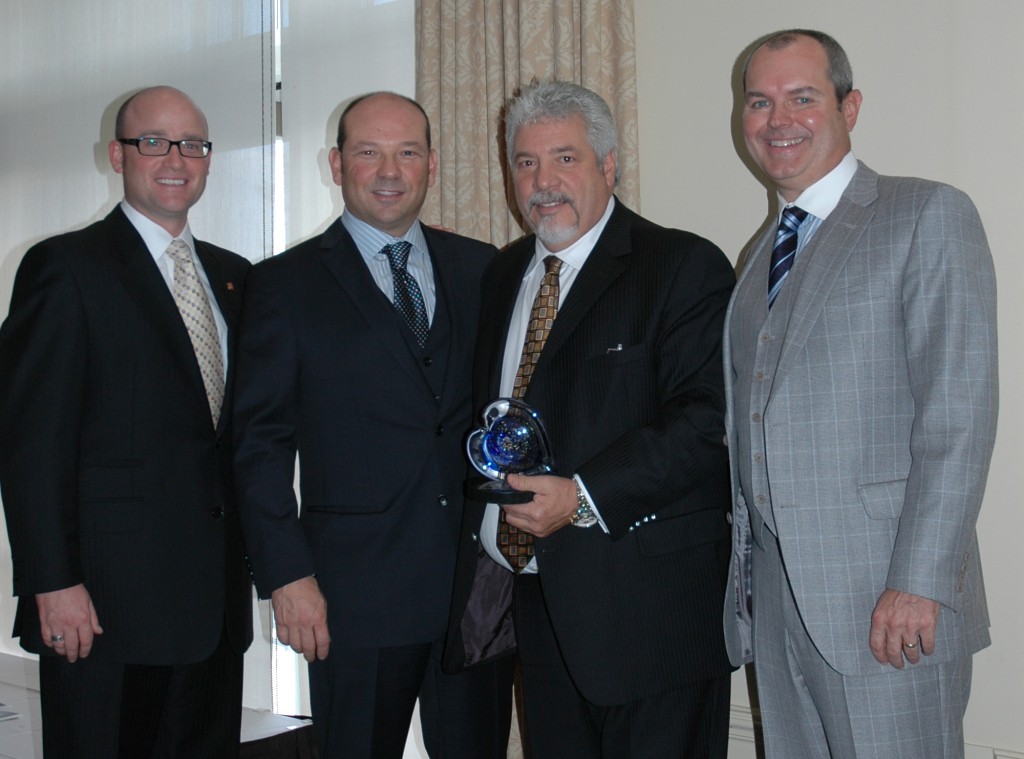
Fred & Lino Losani (centre) receive AFP award

The Association of Professional Fundraisers, Golden Horseshoe Chapter, honours one company each year for its philanthropic support to the community. This year that honour went to Losani Homes, recognized for their leadership and community spirit at a luncheon in November. The company supports many worthwhile causes, including the Community Child Abuse Council, Hamilton Food Share, and the Good Shepherd. And their support is increasing, reaching further to do more for the community. That takes not only a healthy bottom line in business terms, but also a commitment to ongoing philanthropy that is not simply based on quarterly results. Kudos to them for demonstrating just such a commitment and strengthening this community in so many ways.


The Twinkle in Mohawk’s Eye

19 11 2010

Hamilton may be known as a university town, but right now it’s Mohawk College adding some sparkle and polish to the steel city. The new campus renovations, including an impressive new Learning Exchange building, are the twinkle in Mohawk College’s eye, and that eye is apparently fixed confidently on the future. Great expanses of glass, some of it in a rainbow of subtle colours, command attention along the new Fennel Avenue facade. Lettering on the new

(Photo: Mohawk College)

sign (with new logo) is some 5 ft. tall. The new Cummings Library has enhanced wireless access, e-learning and an innovative “collaboratory”. Common spaces abound, with sofas and large booths as well as more traditional seating. And, yes, there’s even a Starbucks. The college calls it “a new campus for a new decade”.

(Mohawk College)

This week the college is hosting several events that are part of The Hamilton Music Awards, and is one of the presenting sponsors. Showcasing local talent and honouring area musicians, this is a fitting venue for Mohawk College to encourage and attract young music students and connect with its community. Rob MacIsaac, President, describes Hamilton as “a great place to learn” thanks in part to Mohawk College and “a great place to call home” thanks in part to the musical icons and upcoming stars being recognized this weekend.

The festival and conference portions of the 5-day event are now on, with the Industry Awards on Saturday evening and the Hamilton Music Awards on Sunday evening (including a lifetime achievement award to Lighthouse founder and Hamiltonian Ronn “Skip” Prokop). Many talented people will walk the halls of Mohawk College for these events, including young talents whose future may well include enrollment at Mohawk. The new campus additions bode well for tomorrow’s student body and for Hamilton, with exemplary environmental design features and an obvious nod to learning comforts. Named the Centre for Entrepreneurship, Learning and Innovation this is the college’s largest-ever project and it is aptly named. The official opening won’t happen until January 2011 but already it’s apparent that the campus has been transformed.

Turns out Hamilton isn’t just a university and college town, it’s home to some of the most innovative educational facilities found anywhere. And, for Mohawk College, this most recent achievement came without aid of federal funds (requested but denied when infrastructure money was being allocated). That’s no small accomplishment, and something to be applauded.


The Poverty Push

11 11 2010

“If a free society cannot help the many who are poor, it cannot save the few who are rich.” (John F. Kennedy, speech Jan. 20, 1961)

Polling conducted around the time of Hamilton’s recent municipal election revealed the issue of poverty as one of significant importance to local voters. In fact, it led the list of burning election issues. Some found this surprising, given the economic upheavals we have faced and the uncertainties of stadium, football team, steelmaker pensions and other local challenges. How heartening to know that Hamiltonians are looking for more and better solutions to the poverty crisis. The push, it appears, is on. Media attention has been significant, and the buzz in the community has reached near vuvuzela proportions.

[Illustration: projectanalog.wordpress.com

Now that the election is over, what can we expect? Will our newly elected representatives pay heed to the significance of this issue? Are we to finally see a coordinated and concerted effort to address poverty in Hamilton? Only time will tell. We’ll have to keep the volume turned up and continue to voice our opinions. Community leaders will need to continue their efforts at collaborating in search of new and effective solutions. There is a role for each of us in the poverty push – voters and volunteers, concerned citizens and families, educators and service providers, businesspeople and students, faith communities and corporations. Whether we give voice or give time, make a donation or make a difference in other ways, we are the force behind the poverty push. We need to be informed and engaged, and to be diligent in our monitoring of Hamilton’s progress.

The rallying cry is “making Hamilton the best place to raise a child”. To get to that, we’ll need to sort out the line-ups at the hot meal programs, the staggering numbers depending on food banks, the waiting list for social services, the lack of a living wage for many, and the inertia that has allowed this community to reach this state. That’s a tall order, but essential.


From Dr. Seuss to Porn

20 10 2010

Parent Evening

The Community Child Abuse Council of Canada presents a special evening for parents on Monday, October 25 as part of its Child Abuse Prevention Month activities. The free evening event features Cordelia Anderson, a recognized expert in child maltreatment. Anderson will engage parents, caregivers and foster parents in a dialogue about what she calls our “sexually toxic” society and how to help children navigate this potentially dangerous landscape.

Pre-registration is required: call (905) 523-1020 ext. 14 or visit the Council’s web site: www.childabusecouncil.on.ca for more information.

On Tuesday, October 26 Cordelia Anderson will be the featured speaker at an all-day symposium for professionals. The focus of the day includes the sexual development of children and the impact of today’s cultural norms and sexually permissive media. For full information visit www.childabusecouncil.on.ca or call the Council: (905) 523-1020 ext. 14. Registration fee is $75.00 per person and space is limited.


Alternatives for Youth

20 10 2010

The annual general meeting of Alternatives for Youth (AY) was held this week, and the election of volunteer board members saw a group of dedicated individuals take up the governance and leadership of the agency for the coming year. This is a small organization, not particularly well known, but a vital provider of services for local young people. AY provides substance abuse and addiction counselling and related programs for youth aged 12-23 and their families in the Hamilton area. They operate from a downtown location and several satellites, including numerous school-based locations.

Karen has been working with AY over the past year, assisting in a Review & Renewal process encompassing all areas of the organization. This has been a substantial undertaking for the agency, and has required considerable work on the part of volunteer board members in particular. The agency should be commended for its efforts to strengthen both governance and service delivery, and for its commitment to making valuable and visionary contributions to the Hamilton community. The AY staff team continues to provide much-needed services to young people and their families in the complicated realm of addiction, substance use, mental health and development.

If you are interested in the work of AY, or about volunteering in a governance or other capacity, contact Sue Kennedy, Executive Director, at (905) 527-4469.


World Food Day

16 10 2010

October 16 is World Food Day. This year, the theme of the day is “united against hunger”.

We are fortunate in Canada to be among the world’s healthiest populations and producers of significant amounts of food. From grains to fish, our ability to draw from the land and waters is abundant. Still, we have our own problems with hunger. Many find this surprising, but we nonetheless have a sizeable number of people in this country who do not get adequate food on a regular basis. Food banks, hot meal programs, community gardens, and various public health and community initiatives are aimed at this food insecurity problem. Here in Hamilton, local farmers and concerned donors have joined in the battle against hunger. Hamilton Food Share was out in those fields today, receiving freshly-harvested carrots destined for food banks in the coming days. Increasing the amount of fresh food available to food bank users is just one of the challenges facing local service providers.

In coming weeks Karen will be working with the Hamilton Community Foundation to support a community initiative aimed at bringing enhanced nutrition and food intake to local schools. Hunger hits children particularly hard, negatively affecting their development and learning. More than 8,000 children use local food banks despite breakfast programs and school nutrition initiatives. Watch for future updates about the local food insecurity landscape and the Hamilton Community Foundation initiative.

Of interest, the UN’s Food and Agriculture Organization has a world hunger map indicating levels of food insecurity and hunger around the globe. With the exception of Australia and New Zealand, the current map shows the entire southern hemisphere as being hungry to varying degrees. North of the equator, parts of Central America, Mexico, the Caribbean, China, the Middle East and Southeast Asia are indicated on the map as experiencing some level of hunger but nowhere in North America, Europe, Scandinavia, Japan, or the rest of Asia.

For more information, visit www.fao.org.

To support local food banks, go to: www.hamiltonfoodshare.org. Every $1 in donations raises $5 in food. To support the Hamilton Community Foundation, go to: www.hcf.on.ca.

You can add your name to the worldwide anti-hunger petition by going to: www.1billionhungry.org.