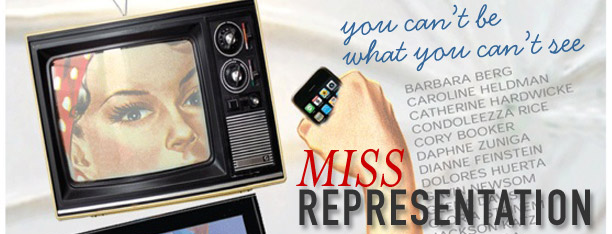
You can’t be what you can’t see

23 10 2011

Here’s an exciting and worthy project aimed at empowering young women and changing the portrayal of young girls in the media…MissRepresentation addresses this in several important ways. If you’ve looked closely at a young girl lately you may have noticed the jeans, the makeup, the hair…much of it a predictable response to perceieved expectations that, for many, go hand in hand with being young and female in our society. Too many young girls spend tremendous effort and money trying to live up to something they’ll never achieve — and who wants them to? The potential cost of these misguided priorities is substantial – their confidence, their time, and a distraction away from the other skills or hobbies or attributes they could be pursuing. In fact, some young girls are literally dying to live up to “an image.”

Driven by the message delivered in the film Miss Representation, a documentary that premiered at the 2011 Sundance Film Festival, the project is “a call-to-action campaign that seeks to empower women and girls to challenge limiting labels in order to realize their potential”. Among its goals are the eradication of gender stereotypes and the creation of lasting cultural and sociological change. The project includes an educational curriculum, film screenings, and an action agenda with options for supporting the campaign.


Check out the details at www.missrepresentation.org


“The Cruelty Crisis”

14 08 2011

Dr. Brené Brown

Here’s an interesting and thought-provoking take on bullying from Dr. Brené Brown (Professor and researcher, University of Houston, Graduate College of Social Work). She draws our attention not to the kids we typically associate with schoolyard trauma or to the teens whose angst can have devastating results, but to our own (adult) behaviours and our society’s tolerance of cruelty. Recommended reading.

http://www.psychologytoday.com/blog/ordinary-courage/201010/the-cruelty-crisis-bullying-isnt-school-problem-its-national-pastime


Feed The Dream

15 04 2011

Did you know that in Hamilton more than 23,000 students get a breakfast, lunch and/or snack each day at their local school or community centre? Many of these kids, 1 in 4, live in poverty. Others lack the required nutrition to get them through the day because busy lives, work schedules, or stressful home situations get in the way. Hamilton Partners in Nutrition (HPIN) provides nutritional meals and snacks to students across this community, funded largely through provincial money but relying also on donations and fundraising. Rising food costs require ongoing efforts to raise money and a significant dependence on volunteer dedication.

On Saturday, June 18th you can support their work by supporting their Feed The Dream Auction. It will be held at Hamilton’s Discovery Centre and will include both silent and live auction events as well as entertainment and hors d’oevres. Opportunities to help include buying event tickets, donating auction items, volunteering for the evening, or advertising in the auction brochure. EnMark Associates is pleased to be donating an auction item, and challenges readers of this site to do the same.

Full details can be found at www.partnersinnutrition.ca or by calling 905-522-1148, ext. 301.  Be sure to find out about the special pre-auction cruise aboard The Harbour Queen.

There are more than 100 student nutrition programs in Hamilton, and as of June 2010 they serve 447,183 breakfast meals and 650,690 snacks with the help of 6,695 volunteers. Parents alone contribute more than 45,000 hours of volunteer time, estimated to represent more than $750,000.


Karen’s recent work has included a project with the Hamilton Community Foundation and area stakeholders to develop a universal school-based nutrition program in Hamilton. Buildiing from what is already in place, the initiative aims to make nourishment available to all elementary school students (secondary school population would come next) and to help the community move forward towards the goal of being the best place in which to raise a child. Watch this blog and the Hamilton Community Foundation’s web site (see link at right) for updates on the project.


Campaign for a Commercial-Free Childhood

8 04 2011

McDonald's ad, Austria

 Regular readers will know that I have talked about this topic often – the commercialization of childhood and the inappropriate (and damaging) marketing of everything under the sun to kids. More often than not the messages are highly sexualized, exploiting the very innocence that ought to be protected.

Here are two resources you may find interesting. It’s nice to share other voices and reassuring to know others are ranting about this too.

www.commercialalert.org: their mission is “to keep the commercial culture within its proper sphere, and to prevent it from exploiting children and subverting the higher values of family, community, environmental integrity and democracy”. Check out their Parents’ Bill of Rights and campaign to get salespeople out of schools.

Our nation is in the grips of a commercial hysteria. Sometimes it seems like everything is for sale. At Commercial Alert, we stand up for the idea that some things are too important to be for sale. Not our children. Not our health. Not our minds. Not our schools. Not our values. Not the integrity of our governments. Not for sale. Period.

www.commercialexploitation.org: national organization (U.S.) devoted to limiting the impact of commercial culture on children – their mission is “to reclaim childhood from corporate marketers”. Good resources and attention to diverse issues (from obesity to violence) along with clout in their advocacy efforts – they have successfully battled Disney, Scholastic Inc. (Bratz), McDonald’s and Hasbro. 

The commercialization of childhood is the link between many of the most serious problems facing children, and society, today.  Childhood obesity, eating disorders, youth violence, sexualization, family stress, underage alcohol and tobacco use, rampant materialism, and the erosion of children’s creative play, are all exacerbated by advertising and marketing.  When children adopt the values that dominate commercial culture—dependence on the things we buy for life satisfaction, a “me first” attitude, conformity, impulse buying, and unthinking brand loyalty—the health of democracy and sustainability of our planet are threatened.  CCFC works for the rights of children to grow up—and the freedom for parents to raise them—without being undermined by commercial interests.

CCFC is active in the Toronto area where a recent campaign helped stop the installation of digital monitors in area highschools (along with their ad content)…anyone involved with CCFC in Hamilton???


Sad Day to be a Girl

18 03 2011

Maybe it’s the warmer weather, or the peek of colour from crocus blooms in my garden today, but I started off with such a cheery disposition…then the media barrage began. First I read that this coming Sunday, March 20th, is the first International Anti-Street Harassment Day. Apparently a day is needed to remind us that catcalls, leers, sexual innuendo and whistles (aka street harassment) are inappropriate. I would like to think offensive behaviour is just that, offensive. Should be out of bounds each and every day. Activists would likely say I’m naive. I can’t fault their efforts to educate, and I recognize that this offensive harassment is often trivialized. According to www.StopStreetHarassment.com street harassment “includes sexually explicit comments, catcalls, groping, leering, stalking and assault, and more than 80 per cent of women have encountered it”. Learning that grim statistic makes me think a day set aside to expose the offenders isn’t such a bad idea (sad, but necessary).

Moving on with my day, I next discovered that Mattel Inc. has launched a new Barbie, called Clawdeen Wolf. This new doll’s purpose is…are you ready?…to help teach young girls about plucking and shaving. Now, I don’t want you to think I’m picking on Mattel here, but seriously…there are just too many issues here not to raise a few red flags. First, Clawdeen is clad in a micromini skirt, baring her navel, and is a ridiculous but no-longer-surprising size 2. It gets worse. The Globe & Mail reports that she boasts of being “a fierce fashionista with a confident no-nonsense attitude” and that shaving and plucking her “freaky flaws” is “a full-time job” (she’s a werewolf’s daughter, according to Mattel’s Monster High web site). Does Mattel think that the little girls who will actually play with this Barbie are in need of shaving guidance? More to the point, does Mattel see body hair as “a freaky flaw” and intend for young girls to see it that way too? Yes, Clawdeen is a toy. But she’s obviously marketed to young girls, and as toys go this is but another example of being off the mark in so many ways. I’ve said it before, and I’ll say it again…manufacturers need to hear from us when they so blatantly target children with messages that are sexualized and age inappropriate. Parents will no doubt be the most influential censors where purchases are concerned, but in the spirit of “it takes a village” (and recognizing that parents need all the help they can get) we should be all be offended, and vocally so. The Globe & Mail reports that Clawdeen is already a big seller, quoting a Toys ‘R’ Us spokesperson saying that Clawdeen is “the most popular fashion doll that we have today” and a Mattel spokesperson (defending the doll), saying she is “all about celebrating your imperfections and accepting the imperfections of others.”

Yes, it started out as a nice (almost spring) day. But it has turned out to be a sad day to be a girl.


Food, Glorious Food

26 01 2011

All things organic, local and sustainable are on the agenda for the upcoming Hamilton food policy conference (a first). “Hammering Out a Food Policy for Hamilton: Preparing the Ground” is set for Thursday, February 10th at the Royal Botanical Gardens and will feature speakers (including Gord Hume, author of Local Food Revolution), presentations, workshops and networking. Registration deadline is February 4th. Cost for the full day event is $30 including refreshments and lunch (local and healthy, of course!).

The event is hosted by the Community Food Security Stakeholders Committee, Hamilton Eat Local, and Slow Food Hamilton. These groups may not be particularly well known but are part of an increasing movement to connect local residents with the foods they eat. They will mark February as Farm Month, for example, with various events (for details go to www.environmenthamilton.org) including a gathering at the newly-renovated Hamilton Farmers’ Market and a food film festival on Locke St.

Growing your own vegetables this year? Interested in ways to eat local all year round? Or just wondering what sustainable agricultural policy looks like? These events are for you. A nice opportunity to escape winter and think about seeds, soil and Savoy cabbage instead of snow and shovels for a bit. And, if you’re a parent, these promise many teachable moments…how far, for example, did the items on your dinner menu tonight have to travel before making it to your table? Do your teens know where they can get a locavore pizza? Did you know you can volunteer for a local fruit tree project to pick (and share) fruit that would otherwise go to waste? Fun to find out, and important information for community members who agree that  local food is better food.


Gas Up!

15 12 2010

Today, December 15th, you can help the CHML/Y108 Children’s Fund by filling your tank at any area Pioneer gas station. One cent from each litre pumped will be donated to the Fund. Tell your friends!


The Twinkle in Mohawk’s Eye

19 11 2010

Hamilton may be known as a university town, but right now it’s Mohawk College adding some sparkle and polish to the steel city. The new campus renovations, including an impressive new Learning Exchange building, are the twinkle in Mohawk College’s eye, and that eye is apparently fixed confidently on the future. Great expanses of glass, some of it in a rainbow of subtle colours, command attention along the new Fennel Avenue facade. Lettering on the new

(Photo: Mohawk College)

sign (with new logo) is some 5 ft. tall. The new Cummings Library has enhanced wireless access, e-learning and an innovative “collaboratory”. Common spaces abound, with sofas and large booths as well as more traditional seating. And, yes, there’s even a Starbucks. The college calls it “a new campus for a new decade”.

(Mohawk College)

This week the college is hosting several events that are part of The Hamilton Music Awards, and is one of the presenting sponsors. Showcasing local talent and honouring area musicians, this is a fitting venue for Mohawk College to encourage and attract young music students and connect with its community. Rob MacIsaac, President, describes Hamilton as “a great place to learn” thanks in part to Mohawk College and “a great place to call home” thanks in part to the musical icons and upcoming stars being recognized this weekend.

The festival and conference portions of the 5-day event are now on, with the Industry Awards on Saturday evening and the Hamilton Music Awards on Sunday evening (including a lifetime achievement award to Lighthouse founder and Hamiltonian Ronn “Skip” Prokop). Many talented people will walk the halls of Mohawk College for these events, including young talents whose future may well include enrollment at Mohawk. The new campus additions bode well for tomorrow’s student body and for Hamilton, with exemplary environmental design features and an obvious nod to learning comforts. Named the Centre for Entrepreneurship, Learning and Innovation this is the college’s largest-ever project and it is aptly named. The official opening won’t happen until January 2011 but already it’s apparent that the campus has been transformed.

Turns out Hamilton isn’t just a university and college town, it’s home to some of the most innovative educational facilities found anywhere. And, for Mohawk College, this most recent achievement came without aid of federal funds (requested but denied when infrastructure money was being allocated). That’s no small accomplishment, and something to be applauded.


Old Spice?

9 11 2010

Marketing magazine recently reported that Canadians are fans of the current Old Spice advertising campaign (“You like the way I look. Of course you do.”). Not only was it the most recognized campaign, it was also the best liked in this country (least liked? The family chasing the Dairy Queen Blizzard truck).

Flash back for a moment to 1965 and imagine the likelihood of either of these marketing campaigns being successful. A naked guy taunting us from the shower? A family drive with Mom on the hood of the car trying to grab hold of an ice cream truck? Doubtful these would ever have been conceived, let alone aired and memorable. My point here is that things have changed considerably in the way marketing reaches us. More disturbing to me is the change in how it affects us, and what has become acceptable to so many of us.

The so-called “prime time” viewing slots on television have opened up to include programming that once was restricted to much later hours and intended for adults only. Shows like “Pimp My Ride” and “Desperate Housewives” are now airing when young kids are still in their living rooms. Not that long ago, Brooke Shields caused a tremendous uproar by exposing her navel and midrift in an advertising campaign. Bratz dolls have sexed up their wardrobes to the point that once-fashionable Barbie has now donned similar garb in order to stay “trendy” and competitive. The cast of Glee on the cover of GQ magazine has been in the news for its racy portrayal of highschool kids, and children have come to know firefighters in most communities as heroes and calendar pinups.

There’s only one common element in all this, and it’s money. Whatever sells goes. And we buy it. Every lowdown, inappropriate and disrespectful moment of it. Maybe our filters are so tired from trying to screen and distinguish among all this stuff that they just don’t work anymore. Or maybe we’ve just become numb to all the skin and sex and selling. Old Spice sales reportedly are up, and Bratz dolls are again being touted as a must-have item for the holidays this year. Trouble is, child abuse is up too. Domestic assaults are still a plague on families. Pornography still nets kids and ruins lives. The links are obvious. What we do about it is trickier.

Stop advertising? No. Censor more of this stuff? Governments won’t do it. Quit spending our money on the products and services that try to sell to kids with sex and violence? Now that just might work. I spoke to a mother the other day who had been trying to explain to her 8-year old why a particular mannequin’s outfit was inappropriate for school (mini skirt, lacy tights, spaghetti strap/sequin top). It’s not easy. I admire her taking a stand though, and she showed that it can be done (and done at any age) with patience and love. She told me she’d rather put up with a few tantrums than risk the alternative.

Can we find more ways to reinforce the appropriate, and gradually reduce the inappropriate, from our lives and the lives of young children? Can we do a better job of turning trashy TV into teachable moments for kids? I think so. And I tip my hat to all those parents out there who are trying to do just that every day. Their task is daunting, and they could use our help and reinforcement. Whether you have children or not, take opportunities to voice your disapproval when the merchandise in the next store you visit falls well short of the mark for appropriateness. As I often hear teachers and parents telling children, “use your voice”.

Photo: spreadshirt.com


Changing our Sexually Toxic Environment

2 11 2010

Cordelia Anderson

If you read this blog regularly, you know that Cordelia Anderson recently spoke about our “sexually toxic environment” as part of a discussion here in Hamilton during Child Abuse Prevention Month (October). Her insights and revelations about “porn culture” and what we must do to reverse the hijacking of our sexuality fired up those who were fortunate enough to be present – and I hope that lasts! In the meantime, I took to heart Cordelia’s message about doing what we can, in our own circles of influence, to rid ourselves of the overly sexual (“hypersexualized”) danger zone in which we (and youngsters) live.

While traveling, I now request a “porn free” room when I make hotel reservations. This means insisting on a room that doesn’t have pay-per-view pornography or has blocked the availability of it during my stay. Families as well as individuals can do this easily…and the more who do, the more likely we are to find greater availability of these rooms.

While shopping, I no longer turn away and ignore inappropriate or offensive merchandise. I recently pointed out to a shopkeeper that a particularly sexual t-shirt had no place on display in a store selling children’s clothing. In another, I complained about a line of merchandise called “Porn for Women” that was prominently displayed in the gift shop of a heritage site (go figure). In both cases, I elected to shop elsewhere and let them know why this was my decision.

These individual efforts do pay off. After complaining about a rubber tag for sale in a local dollar store (“On Myspace I’m Legal”) – displayed next to Dora The Explorer and other kids’ items – the store not only removed it from their inventory but also invited me to write to their head office and explain why it’s unacceptable. Pointing out the inappropriateness of sexualized merchandise can lead to an “aha” moment for sales clerks, store managers, buyers and distributors. Community-minded corporations will often respond when made aware of merchandise that might otherwise have slipped through their radar.

There are a host of things we can do, each of us, to change our environment so that these hypersexualized examples are not considered “normal”. First and foremost, remember that money talks. Spend it strategically. If you don’t think dolls for young girls should be dressed in feather boas and miniskirts, don’t buy them. And let store staff know why you won’t spend your money on these items. If you don’t think the lyrics to certain songs are healthy for the sexuality of our young people, point that out to them. Explain what’s degrading or objectifying about the words, and offer empowering messages instead.

Simply starting a conversation can be enough to get the ball rolling. How do you feel about the mainstream TV line-up including shows like “Pimp My Ride”? What about the results you get when you search for “porn” on Google? For an interesting comparison, Cordelia Anderson suggests trying that search and then searching for “healthy sexuality” and seeing the difference in results (and the time it takes).

October was Child Abuse Prevention Month. November is the month set aside to talk about woman abuse and to raise awareness about the problem. If we only address these issues once a year, we can pretty much give up on making any inroads. If we continue to let media and merchandisers degrade and objectify women, we won’t get very far either. So speak up, engage others, and spend strategically. It will take all of us to make a difference in what “normal” consists of and whether messages about healthy sexuality are available to young people.

“The need for change bulldozed road down the center of my mind”.

Maya Angelou