You can’t be what you can’t see

23 10 2011

Here’s an exciting and worthy project aimed at empowering young women and changing the portrayal of young girls in the media…MissRepresentation addresses this in several important ways. If you’ve looked closely at a young girl lately you may have noticed the jeans, the makeup, the hair…much of it a predictable response to perceieved expectations that, for many, go hand in hand with being young and female in our society. Too many young girls spend tremendous effort and money trying to live up to something they’ll never achieve — and who wants them to? The potential cost of these misguided priorities is substantial – their confidence, their time, and a distraction away from the other skills or hobbies or attributes they could be pursuing. In fact, some young girls are literally dying to live up to “an image.”
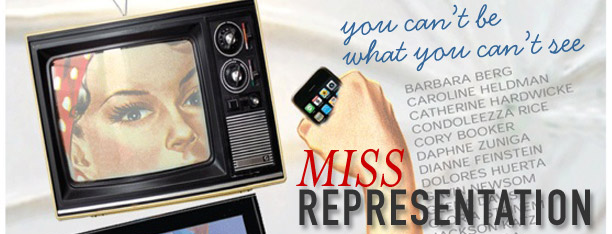
Driven by the message delivered in the film Miss Representation, a documentary that premiered at the 2011 Sundance Film Festival, the project is “a call-to-action campaign that seeks to empower women and girls to challenge limiting labels in order to realize their potential”. Among its goals are the eradication of gender stereotypes and the creation of lasting cultural and sociological change. The project includes an educational curriculum, film screenings, and an action agenda with options for supporting the campaign.


Check out the details at www.missrepresentation.org



1 in 3 Women

4 04 2011

Ontario’s new Sexual Violence Action Plan: Changing Attitudes, Changing Lives addresses a “serious and pervasive” problem in this province. It speaks frankly (“violence against women devastates lives – it has no place in society and it will not be tolerated”) and includes a commitment of $15 million over four years ($5.2 M for public education campaigns, $1.6 M for professional training and education, $3 M for sexual assault centres, $3.7 M for interpreter services, $1.95 M for anti-human trafficking initiatives). 

Many Ontarians don’t realize the alarming statistics surrounding sexual violence and its prevalence in the lives of far too many women. One in three women will experience some form of sexual assault in their lifetime. Sexual violence crosses all social boundaries, affects women of every age and cultural background, and has devastating impacts on the lives of victims and their families as well as the well-being of society as a whole. [Laurel Broten, Minister Responsible for Women’s Issues, Sexual Violence Action Plan, March 2011].

The plan updates the Province’s former “domestic violence” action plan (2004) and addresses crimes such as sexual assault, sexual exploitation through human trafficking, sexual harassment, and sexual exploitation using technology and the Internet. It focuses on sexual violence against those 16 years of age and older (the Plan reports that separate initiatives are being developed for children and for men).

Many people only think of sexual violence as a very violent crime that happens between strangers – the perpetrator lurking in a dark alley or in the bushes. In reality, most sexual assaults are committed by someone known to the victim – an acquaintance, date, friend, colleague or family member – and often it occurs in private places, like the victim’s home [Ontario’s Sexual Violence Action Plan].

The Plan acknowledges that current statistics are alarming and that women across Ontario live in fear. The crime that is sexual violence won’t be curtailed successfully by any one effort or approach alone, thus it is heartening to see prevention as well as post-incident response included in the Province’s approach. The stated vision in the Plan is that “Ontario is a place where all women live in safety, and are free from the threat, fear or experience of sexual violence”. Published progress reports are promised after two and four-year intervals (2013 and 2015).

No less than 16 provincial Ministries are listed in the Plan as partners in the effort and members of the Ministerial Steering Committee on Violence Against Women, and the Plan highlights several collaborative approaches. It is nonetheless unfortunate that the leadership in launching this Plan came from the Minister Responsible for Women’s Issues. Sexual violence is not a “women’s issue”. But the Plan does include a request from the Province for changes to the Criminal Code of Canada and that’s a positive step in the battle against electronic victimization (among the newest threats). Also welcomed is the Province’s financial investment in education, prevention and victim response initiatives.

For a full version of the 23-page Plan click here: Ontario’s Sexual Violence Action Plan 2011.


Sad Day to be a Girl

18 03 2011

Maybe it’s the warmer weather, or the peek of colour from crocus blooms in my garden today, but I started off with such a cheery disposition…then the media barrage began. First I read that this coming Sunday, March 20th, is the first International Anti-Street Harassment Day. Apparently a day is needed to remind us that catcalls, leers, sexual innuendo and whistles (aka street harassment) are inappropriate. I would like to think offensive behaviour is just that, offensive. Should be out of bounds each and every day. Activists would likely say I’m naive. I can’t fault their efforts to educate, and I recognize that this offensive harassment is often trivialized. According to www.StopStreetHarassment.com street harassment “includes sexually explicit comments, catcalls, groping, leering, stalking and assault, and more than 80 per cent of women have encountered it”. Learning that grim statistic makes me think a day set aside to expose the offenders isn’t such a bad idea (sad, but necessary).

Moving on with my day, I next discovered that Mattel Inc. has launched a new Barbie, called Clawdeen Wolf. This new doll’s purpose is…are you ready?…to help teach young girls about plucking and shaving. Now, I don’t want you to think I’m picking on Mattel here, but seriously…there are just too many issues here not to raise a few red flags. First, Clawdeen is clad in a micromini skirt, baring her navel, and is a ridiculous but no-longer-surprising size 2. It gets worse. The Globe & Mail reports that she boasts of being “a fierce fashionista with a confident no-nonsense attitude” and that shaving and plucking her “freaky flaws” is “a full-time job” (she’s a werewolf’s daughter, according to Mattel’s Monster High web site). Does Mattel think that the little girls who will actually play with this Barbie are in need of shaving guidance? More to the point, does Mattel see body hair as “a freaky flaw” and intend for young girls to see it that way too? Yes, Clawdeen is a toy. But she’s obviously marketed to young girls, and as toys go this is but another example of being off the mark in so many ways. I’ve said it before, and I’ll say it again…manufacturers need to hear from us when they so blatantly target children with messages that are sexualized and age inappropriate. Parents will no doubt be the most influential censors where purchases are concerned, but in the spirit of “it takes a village” (and recognizing that parents need all the help they can get) we should be all be offended, and vocally so. The Globe & Mail reports that Clawdeen is already a big seller, quoting a Toys ‘R’ Us spokesperson saying that Clawdeen is “the most popular fashion doll that we have today” and a Mattel spokesperson (defending the doll), saying she is “all about celebrating your imperfections and accepting the imperfections of others.”

Yes, it started out as a nice (almost spring) day. But it has turned out to be a sad day to be a girl.


100 Years of International Women’s Day

7 03 2011


Old Spice?

9 11 2010

Marketing magazine recently reported that Canadians are fans of the current Old Spice advertising campaign (“You like the way I look. Of course you do.”). Not only was it the most recognized campaign, it was also the best liked in this country (least liked? The family chasing the Dairy Queen Blizzard truck).

Flash back for a moment to 1965 and imagine the likelihood of either of these marketing campaigns being successful. A naked guy taunting us from the shower? A family drive with Mom on the hood of the car trying to grab hold of an ice cream truck? Doubtful these would ever have been conceived, let alone aired and memorable. My point here is that things have changed considerably in the way marketing reaches us. More disturbing to me is the change in how it affects us, and what has become acceptable to so many of us.

The so-called “prime time” viewing slots on television have opened up to include programming that once was restricted to much later hours and intended for adults only. Shows like “Pimp My Ride” and “Desperate Housewives” are now airing when young kids are still in their living rooms. Not that long ago, Brooke Shields caused a tremendous uproar by exposing her navel and midrift in an advertising campaign. Bratz dolls have sexed up their wardrobes to the point that once-fashionable Barbie has now donned similar garb in order to stay “trendy” and competitive. The cast of Glee on the cover of GQ magazine has been in the news for its racy portrayal of highschool kids, and children have come to know firefighters in most communities as heroes and calendar pinups.

There’s only one common element in all this, and it’s money. Whatever sells goes. And we buy it. Every lowdown, inappropriate and disrespectful moment of it. Maybe our filters are so tired from trying to screen and distinguish among all this stuff that they just don’t work anymore. Or maybe we’ve just become numb to all the skin and sex and selling. Old Spice sales reportedly are up, and Bratz dolls are again being touted as a must-have item for the holidays this year. Trouble is, child abuse is up too. Domestic assaults are still a plague on families. Pornography still nets kids and ruins lives. The links are obvious. What we do about it is trickier.

Stop advertising? No. Censor more of this stuff? Governments won’t do it. Quit spending our money on the products and services that try to sell to kids with sex and violence? Now that just might work. I spoke to a mother the other day who had been trying to explain to her 8-year old why a particular mannequin’s outfit was inappropriate for school (mini skirt, lacy tights, spaghetti strap/sequin top). It’s not easy. I admire her taking a stand though, and she showed that it can be done (and done at any age) with patience and love. She told me she’d rather put up with a few tantrums than risk the alternative.

Can we find more ways to reinforce the appropriate, and gradually reduce the inappropriate, from our lives and the lives of young children? Can we do a better job of turning trashy TV into teachable moments for kids? I think so. And I tip my hat to all those parents out there who are trying to do just that every day. Their task is daunting, and they could use our help and reinforcement. Whether you have children or not, take opportunities to voice your disapproval when the merchandise in the next store you visit falls well short of the mark for appropriateness. As I often hear teachers and parents telling children, “use your voice”.

Photo: spreadshirt.com


Changing our Sexually Toxic Environment

2 11 2010

Cordelia Anderson

If you read this blog regularly, you know that Cordelia Anderson recently spoke about our “sexually toxic environment” as part of a discussion here in Hamilton during Child Abuse Prevention Month (October). Her insights and revelations about “porn culture” and what we must do to reverse the hijacking of our sexuality fired up those who were fortunate enough to be present – and I hope that lasts! In the meantime, I took to heart Cordelia’s message about doing what we can, in our own circles of influence, to rid ourselves of the overly sexual (“hypersexualized”) danger zone in which we (and youngsters) live.

While traveling, I now request a “porn free” room when I make hotel reservations. This means insisting on a room that doesn’t have pay-per-view pornography or has blocked the availability of it during my stay. Families as well as individuals can do this easily…and the more who do, the more likely we are to find greater availability of these rooms.

While shopping, I no longer turn away and ignore inappropriate or offensive merchandise. I recently pointed out to a shopkeeper that a particularly sexual t-shirt had no place on display in a store selling children’s clothing. In another, I complained about a line of merchandise called “Porn for Women” that was prominently displayed in the gift shop of a heritage site (go figure). In both cases, I elected to shop elsewhere and let them know why this was my decision.

These individual efforts do pay off. After complaining about a rubber tag for sale in a local dollar store (“On Myspace I’m Legal”) – displayed next to Dora The Explorer and other kids’ items – the store not only removed it from their inventory but also invited me to write to their head office and explain why it’s unacceptable. Pointing out the inappropriateness of sexualized merchandise can lead to an “aha” moment for sales clerks, store managers, buyers and distributors. Community-minded corporations will often respond when made aware of merchandise that might otherwise have slipped through their radar.

There are a host of things we can do, each of us, to change our environment so that these hypersexualized examples are not considered “normal”. First and foremost, remember that money talks. Spend it strategically. If you don’t think dolls for young girls should be dressed in feather boas and miniskirts, don’t buy them. And let store staff know why you won’t spend your money on these items. If you don’t think the lyrics to certain songs are healthy for the sexuality of our young people, point that out to them. Explain what’s degrading or objectifying about the words, and offer empowering messages instead.

Simply starting a conversation can be enough to get the ball rolling. How do you feel about the mainstream TV line-up including shows like “Pimp My Ride”? What about the results you get when you search for “porn” on Google? For an interesting comparison, Cordelia Anderson suggests trying that search and then searching for “healthy sexuality” and seeing the difference in results (and the time it takes).

October was Child Abuse Prevention Month. November is the month set aside to talk about woman abuse and to raise awareness about the problem. If we only address these issues once a year, we can pretty much give up on making any inroads. If we continue to let media and merchandisers degrade and objectify women, we won’t get very far either. So speak up, engage others, and spend strategically. It will take all of us to make a difference in what “normal” consists of and whether messages about healthy sexuality are available to young people.

“The need for change bulldozed road down the center of my mind”.

Maya Angelou


Canada’s Gender Gap

1 11 2010

November is Woman Abuse Awareness Month, and that has brought a substantial amount of research across my desk that is released or publicized in conjunction with events and activities designed to mark the month and support awareness and advocacy efforts. One of these research reports caught my attention in a big way.

The World Economic Forum has been publishing the Global Gender Gap report since 2006. It tracks national gender gaps in economics, politics, education and health, and ranks countries according to these criteria. This allows for comparisons across regions and income groups, and over time.

Every year since its inception in 2006 , the report has ranked Iceland, Norway, and Sweden in the top spots (Finland made it to #3 this year). The forerunner to this report, Women’s Empowerment: Measuring the Global Gender Gap (published in 2005), ranked Canada in 7th spot. Since then, however, we have fallen significantly in the rankings.

2006 -14th
2007 -18th
2008 – 31st
2009 – 25th
2010 – 20th

The United States (19th this year) closed its gender gap, rising 12 places to enter the top 20 for the first time in the report’s five-year history. Our current federal government took power in 2006 and has obviously not made this a priority. When the subindexes are scrutinized, we find that Canada ranks 10th for women’s economic participation and opportunity, but 60th for health and survival, and 62nd for political empowerment. We are ranked 38th for women’s educational attainment.

Melanne Verveer, US Ambassador-at-Large for Global Women’s Issues, points out that the report “shows a strong correlation between gender equality and a country’s prosperity and economic competitiveness.”

This month, as we contemplate the continued existence of woman abuse in 21st Century Canada, we might also reflect on the missing values that are reflected in Canada’s poor performance in shrinking the gender gap – if women and their contributions to Canadian life are indeed valued, this certainly isn’t mirrored in our ranking or in our failure to end the abuse of women. Like child abuse, we won’t be able to solve this problem with education alone, or prosecution alone, or treatment alone…we’ll need all of these things, and more.

My thanks to Krista at the Sexual Assault Centre (Hamilton & Area) for sharing the global report. For more information, go to www.weforum.org

or find the report at http://www.weforum.org/en/Communities/Women%20Leaders%20and%20Gender%20Parity/GenderGapNetwork/index.htm


Vital Signs

12 10 2010

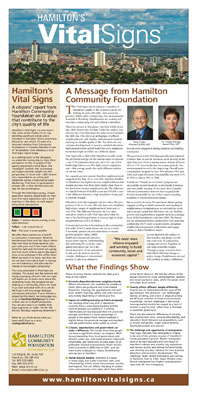
The 2010 Hamilton’s Vital Signs report paints a picture of Hamilton that is described by the Hamilton Community Foundation as “two cities that share the same urban boundary but little else. One city is an archipelago of affluent neighbourhoods with healthy, well-educated residents enjoying an enviable quality of life. The other city concentrates shocking levels of poverty, curtailed education, high unemployment and ill health into poor neighbourhoods that might as well be on a different planet”.

The Foundation calls on us for compassion, outrage and action in response to neighbourhood disparities, poor voter turnout, the need for a “living wage”, growing domestic violence, and child poverty (among other identified trends and issues).

This is required reading for anyone with an interest in bettering the community, predicting future prospects, or engaging more actively in civic life (there’s a great list of things you can do to help). As a city, we’ve come a long way. But as a community emboldened for the future we have considerable work still to do.


On the road for Connections…

15 09 2010

Karen will be facilitating four regional sessions for Connections this month, beginning in St. John’s on September 17th. These sessions will bring together service providers and policymakers for a full day of knowledge exchange about women with substance use issues. Results from Connections’ recent meta-analysis will be shared with participants, who will then inform knowledge exchange planning and strategies to be pursued by researchers during the next phase of Connections’ work. The goal of Connections research is to improve services for women with substance use issues and their children in Canada.  

Scheduled sessions: 

  • Friday, September 17 – St. John’s, Newfoundland
  • Thursday, September 23 – Vancouver, BC
  • Friday, September 24 – Saskatoon, Saskatchewan
  • Friday, October 1 – Ottawa, Ontario

The Canadian Institute of Health Research (CIHR) provided $1.4 million in funding over 5 years for Connections research. The objective is to identify the research needs of nearly 800 agencies working with women who have substance use issues across Canada, and to then develop, implement and evaluate knowledge translation and exchange strategies.  

Connections spokesperson, Alison Niccols, says “findings will help improve services, reduce costs (in terms of crime, unemployment, neonatal intensive care, etc.), and ultimately improve the health of a vulnerable, marginalized population of women and children at high risk for poor outcomes”. The research is timely, she points out, given that substance abuse during pregnancy has been identified as a major public health concern. At least 24,000 Canadians under the age of 21 have Fetal Alcohol Spectrum Disorder and the annual cost to Canadians is more than $344 million according to Connections. 


Maternal use of alcohol and other drugs can have profound effects on child health and development. Many women who continue to abuse substances after childbirth have challenging life circumstances, including lack of affordable housing, diminished capacity for parenting, and difficulties providing stable, nurturing environments for their children. 


Led by researchers from McMaster University and McMaster Children’s Hospital, the Connections project involves collaboration among researchers from the Centre for Addiction and Mental Health, the University of Toronto, the University of Western Ontario, and the University of British Columbia.   

For more information: www.connectionscanada.ca 


Take Back The Night

14 09 2010

A woman walks alone down a dark, deserted street. With every shadow she sees, and every sound she hears, her pounding heart flutters and skips a beat. She hurries her pace as she sees her destination become closer. She is almost there. She reaches the front door, goes inside, collects herself, and moves on forgetting, at least for tonight, the gripping fear that momentarily enveloped her life.

This scene, quoted from the Take Back The Night foundation’s web site, might have unfolded in any city. The fear associated with walking at night, for many women, is the reason Take Back The Night events happen all over the world. What started as a candlelit march in Philadelphia in 1975 has become a symbolic show of unity and purpose held annually in cities everywhere (Canada’s first was in Vancouver, 1978). Marches  take place in September in most Canadian cities. In Hamilton, this year’s march will be on Thursday, September 16th – City Hall, 6:30 pm gathering, 7:30 pm rally, 8:00 pm march.

 Women from New York to India are letting their voices shatter the silence, but there is much to be accomplished in the fight to end sexual violence. Crimes of this nature continue to appear in the news in epidemic proportions. Our movies, our music, and daily news describe another killing, shooting; more abuse, violence and rape. As the history of Take Back the Night continues to be written, its mission to end sexual violence for all remains a beacon of hope for the millions affected by crimes of violence. We have made great strides, but our march is far from over. [Take Back The Night foundation web site]

In keeping with the symbolic gesture of women “taking back the night”, organizers of Hamilton’s march (like the majority) do not open the event to male participants. A separate gathering, with speaker and discussion, is hosted so that men may be allies in the cause and show their support without actually marching (6:30 pm, Skydragon, 75 King William St.).

For more information about the Hamilton event, visit the Sexual Assault Centre (Hamilton and Area) web site: www.sacha.ca. Information about the history of these events and their purpose around the world can be found on the TBTN foundation web site: www.takebackthenight.org.