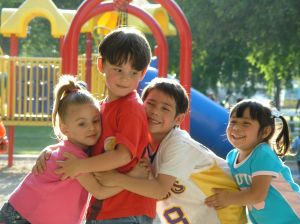
October Marks Child Abuse Prevention Month

30 09 2012

Once again this year, October will see efforts across Ontario to raise awareness about child abuse and to remind us that this is a preventable crime. The maltreatment of children, whether by physical, emotional, or sexual abuse, neglect, or subjecting children to the trauma of witnessing violence…whatever the form, child abuse is unacceptable. It’s a sad fact that this message requires repeating, but it does. The incidence of child abuse remains disturbingly high, and new threats are adding to the problem at alarming rates (online predators, the sexualization of childhood, child porn, involvement of minors in the sex trade). Headlines over this past year have once again exposed the vulnerability of children to adult criminal behaviour, and reminded us that many of these children cannot and do not speak up. Those who do stand a shockingly low chance of getting the specialized help they need. Some will never get help.

Statistics show that 1 in 3 girls and 1 in 6 boys will be sexually victimized before reaching age 18. Think about that the next time you drive by a school yard or see a group of children playing in a park.

We can change the statistics. We can do better for children who need our help. Add your voice to the fight against child abuse. Listen to children, and act when they reveal that they have been maltreated – it’s the law. Learn more about this community’s response to child abuse, lend your support, and encourage others to do the same. Wear a purple ribbon to heighten awareness about child abuse. Help eliminate the stigma attached to child abuse by having open conversations about this important issue. Children are counting on us to do that, not just in October but each and every day.

For more information, visit www.childabusecouncil.on.ca



International Women’s Day

8 03 2012

Regrettably, I haven’t been blogging much of late…a full plate has kept me busily occupied (and quite content) but finding time to blog has been a challenge. Today, however, I had to share a wonderful link to inspire and to acknowledge, to support and to inform…

http://www.youtube.com/watch?feature=player_embedded&v=KQOVUK68mTg

We’ve come a long way since the first IWD, but there is still much to do. I am ever-more convinced of this and acutely aware of the remaining challenges with each day spent working with the brave youngsters, dedicated staff, and generous supporters at the Community Child Abuse Council. To be clear, violence against women or children is not “a women’s issue”. It will, however, take our collective voices at full volume to change the unacceptable reality that 1 in 3 girls (and 1 in 5 boys) will be sexually victimized before adulthood.

Thanks Ayesha, for reminding us to shake the tree.


Wielding Power & Influence

7 11 2011

People in power (and men, in particular) continue to make news headlines for their abuse not only of influence but of children. First we saw the horrific video of a Texas family law judge beating his daughter while spewing a venomous tirade of foul and hurtful language. Next it was former Penn State athletics official, Jerry Sandusky, charged with sexually assaulting eight boys between 1994-2009. In this latter case, other school officials have been charged with perjury and with failing to meet their duty to report suspected or known threats to children and an ongoing investigation continues.

Adding to the Penn State scandal, the accused continued to use the university’s facilities after his retirement in 1999 for his work with The Second Mile, a charity he founded in 1977 for at-risk kids. The organization’s web site lists a who’s who of sports icons and hall of famers on its honourary board (including golf great Arnold Palmer, Heisman Trophy winner John Cappelletti, former Steelers Jack Ham and Franco Harris, retired football coach Lou Holtz, current Penn State football coach Joe Paterno, baseball’s Cal Ripken Jr., actor Mark Wahlberg, and corporate notables from Hershey Foods, Quaker State, Ortho Pharmaceutical, and KMart). One wonders how their potential power and influence might be wielded given the circumstances.

“This is a case about a sexual predator who used his position within the university and community to repeatedly prey on young boys,” said state Attorney General Linda Kelly. Despite being arraigned on 40 criminal counts, Sandusky has been released on bail.

The Texas judge, meanwhile, will apparently not face charges due to the length of time that has elapsed since the (videotaped in 2004) beating took place.  Police in the Texas jurisdiction where Aransas County Court-at-Law Judge William Adams resides have announced that they “believe that there was a criminal offense involved and that there was substantial evidence to indicate that and under normal circumstances … a charge could have been made” but that the statute of limitations for such charges stands at five years (CBS News). An investigation by the state’s judicial conduct commission and the Texas Department of Family and Protective Services is still pending.

These are headlines that have crossed international date lines, but will soon simply become state, and then local, coverage as yet another round of high profile cases dims from the spotlight. Whether you live in Texas or Pennsylvania, or in Ontario, it’s ultimately up to us whether the conversation continues…what do we think about a statute of limitations on crimes like child abuse (that often don’t surface for many years)? How do we feel about sexual predators successfully using youth programs to connect with kids? And what do we imagine is the best we can do to help the children who fall prey to these criminals (or may)? What’s our potential influence here, and are we wielding it in the best interests of children?


Time to speak up

29 10 2011

Our local police force released statistics about crime rates last week, garnering attention both for the drop in overall crimes and for the disturbing increase in certain categories. An increase in the number of local murders, in particular, has resulted  in a 4.2% overall increase in violent crimes vs last year. But the increases in sexual assaults against women and children, and in child pornography, are especially alarming.

Media coverage about the numbers (and some local blogs) quoted area politicians’ reactions to the figures, focused on the costs of policing and the difficulties in comparing numbers across municipalities. Hamilton isn’t Muskoka, one Councillor pointed out. The figures are to be reviewed in more detail. Let’s hope that review considers the costs of these crimes to our community not only in a financial context but in the price paid by victims and their families. Crimes against children, in particular, tear at the very fabric of our neighbourhoods and diminish us all as members of this community.

Hamilton is above the Canadian average for violent crimes. And our rate of sexual assaults against children as well as child pornography has been rising. Policing aside, what are we as a community doing about that? Are we talking about it, outraged by it, seeking solutions to change it? There is much to think about given these latest crime statistics. The thinking cannot be limited, however, to the sphere of law enforcement and municipal government. Conversations need to happen in private homes and coffee shops as well – what do we think about the sentencing handed out to those who prey on children? What messages might we send to make sure the vast majority’s outrage over these despicable crimes is understood?

The burden of finding and apprehending the criminals represented in the statistics rests on our Hamilton Police Service. But they cannot and should not stand as our only response to child abuse, woman abuse, or child pornography. These are crimes with roots in societal issues. These are crimes that send powerful messages, of the very worst kind, to kids. Our continued silence won’t do anything to change that.


October is Child Abuse Prevention Month

2 10 2011

To educate yourself about child abuse, and for information about what each of us can do, please visit www.childabusecouncil.on.ca.

To support the work of the Community Child Abuse Council, marking its 35th anniversary this year, join the fun on October 21st at the Mad Hatter’s Ball: www.the2011mhb.com.


“The Cruelty Crisis”

14 08 2011

Dr. Brené Brown

Here’s an interesting and thought-provoking take on bullying from Dr. Brené Brown (Professor and researcher, University of Houston, Graduate College of Social Work). She draws our attention not to the kids we typically associate with schoolyard trauma or to the teens whose angst can have devastating results, but to our own (adult) behaviours and our society’s tolerance of cruelty. Recommended reading.

http://www.psychologytoday.com/blog/ordinary-courage/201010/the-cruelty-crisis-bullying-isnt-school-problem-its-national-pastime


Latest Briefing from Child Abuse Council

11 05 2011

Regular readers know that the Community Child Abuse Council releases periodic issues of its Leadership Briefing to inform and engage the public. Karen has been authoring these briefings since their inception. The latest release is now available on the Council’s web site (http://www.childabusecouncil.on.ca/) or here: Leadership Briefing Spring 2011


1 in 3 Women

4 04 2011

Ontario’s new Sexual Violence Action Plan: Changing Attitudes, Changing Lives addresses a “serious and pervasive” problem in this province. It speaks frankly (“violence against women devastates lives – it has no place in society and it will not be tolerated”) and includes a commitment of $15 million over four years ($5.2 M for public education campaigns, $1.6 M for professional training and education, $3 M for sexual assault centres, $3.7 M for interpreter services, $1.95 M for anti-human trafficking initiatives). 

Many Ontarians don’t realize the alarming statistics surrounding sexual violence and its prevalence in the lives of far too many women. One in three women will experience some form of sexual assault in their lifetime. Sexual violence crosses all social boundaries, affects women of every age and cultural background, and has devastating impacts on the lives of victims and their families as well as the well-being of society as a whole. [Laurel Broten, Minister Responsible for Women’s Issues, Sexual Violence Action Plan, March 2011].

The plan updates the Province’s former “domestic violence” action plan (2004) and addresses crimes such as sexual assault, sexual exploitation through human trafficking, sexual harassment, and sexual exploitation using technology and the Internet. It focuses on sexual violence against those 16 years of age and older (the Plan reports that separate initiatives are being developed for children and for men).

Many people only think of sexual violence as a very violent crime that happens between strangers – the perpetrator lurking in a dark alley or in the bushes. In reality, most sexual assaults are committed by someone known to the victim – an acquaintance, date, friend, colleague or family member – and often it occurs in private places, like the victim’s home [Ontario’s Sexual Violence Action Plan].

The Plan acknowledges that current statistics are alarming and that women across Ontario live in fear. The crime that is sexual violence won’t be curtailed successfully by any one effort or approach alone, thus it is heartening to see prevention as well as post-incident response included in the Province’s approach. The stated vision in the Plan is that “Ontario is a place where all women live in safety, and are free from the threat, fear or experience of sexual violence”. Published progress reports are promised after two and four-year intervals (2013 and 2015).

No less than 16 provincial Ministries are listed in the Plan as partners in the effort and members of the Ministerial Steering Committee on Violence Against Women, and the Plan highlights several collaborative approaches. It is nonetheless unfortunate that the leadership in launching this Plan came from the Minister Responsible for Women’s Issues. Sexual violence is not a “women’s issue”. But the Plan does include a request from the Province for changes to the Criminal Code of Canada and that’s a positive step in the battle against electronic victimization (among the newest threats). Also welcomed is the Province’s financial investment in education, prevention and victim response initiatives.

For a full version of the 23-page Plan click here: Ontario’s Sexual Violence Action Plan 2011.


Child Honouring

28 03 2011

Canadian children’s entertainer Raffi has a project that is inspiring and worth passing along…you can find details about it at his web site: www.raffinews.com.

“Child Honouring” is the singer/author’s approach to healing communities with a “child first” philosophy…organizing society around the needs of its youngest members. Its founder says “its spirit is invitational – a call to imagine and create a diversity of child-friendly cultures. A child-honouring society would show love for its children, and therefore for all of us, in every facet of its design and organization”.

The Child Honouring project includes a Covenant for Honouring Children along with Child Honouring Principles (for a .pdf version of these, click here: http://www.raffinews.com/files/child_honouring/covenant_principles.pdf. There are also resources for teachers and parents.

Hailed as a “compassion revolution”, Raffi’s project has elements of earth-friendly ecology and global peace as well as child-first concepts that include ideas for action and plenty of inspiration. The project’s Advisory Council includes such notables as Dr. Fraser Mustard (of Early Years fame), Elise Miller (founder and Executive Director of the National Institute for Children’s Environmental Health), Dr. Charles E. Pascal (Executive Director, Atkinson Charitable Foundation) and Joel Solomon (Chair, Tides Foundation).

The Washington Post once called Raffi Cavoukian “the most popular children’s entertainer in the western world”. The Order of Canada recipient is respected not only for his craft and talent, but also for refusing commercial endorsements and shunning marketing directly to children. This latest initiative will undoubtedly elevate his standing as a global advocate for children and an ally to parents and educators everywhere.


A few bad apples…

14 03 2011

March is Fraud Prevention Month, prompting a quiz sponsored by CanadaHelps and Capital One concerning charitable giving. To take the online quiz and see how much you know about charitable fraud, click here: http://www.canadahelps.org/.

Charity fraud is rare in Canada despite media coverage that might suggest otherwise. In more than 20 years working in the charitable sector, with dozens and dozens of organizations, I have never once come across actual fraud. We have a reasonably strict system of monitoring and enforcement here in Canada, making it tough to scam donors or operate fraudulent charities. The Canada Revenue Agency (CRA) pulls the plug on those who try, resulting in loss of charitable status or revoked registration.

Mark Blumberg’s Canadian Charity Law List for this month includes examples of this enforcement in action. “CRA has revoked the registration of The Organ Donation & Transplant Association of Canada for excessive fundraising and administrative fees and for involvement in an ‘international donation arrangement'”. Apparently this organization ran into trouble for gifts in kind whose real value didn’t match their reported value. Then there’s Pediatric AIDS Canada/USA, whose registration was also revoked by CRA for high fundraising costs and involvement in an “international donation arrangement that artificially inflated expenditures on charitable activities”.

Both these organizations were included in a recent Toronto Star article about charity fraud (“Plug pulled on charity after audit reveals money misspent”, March 7, 2011). The article essentially deals with six organizations where cases of charitable spending or reporting breaches led to CRA intervention. I point this out because six organizations out of thousands who conduct themselves legitimately is a very small number. Even if there are other, as yet undiscovered, fraudsters out there they remain a very small percentage of Canada’s overall charitable sector. The damage they inflict, however, can be devastating to all.

Donor diligence is the best defense against making contributions to fraudulent causes. But donors should not become alarmed and think that fraud is rampant in Canadian charities. It is not. A very few bad apples make it extremely challenging for legitimate charities to maintain goodwill and donor trust (and often add to the costs of operating a bona fide charity). Volunteers, too, can be skeptical about supporting the sector if they don’t feel their efforts are aligned with legitimate and legal purposes. So there’s much at stake (donors, volunteers, public opinion) for the good apples.

Updated charity laws, aggressive prosecution of lawbreakers, and accessible information for donors and volunteers are all helping to keep fraud to an absolute minimum in Canada. One bad apple is one too many, but it’s important that the entire sector not be branded criminals by a very few examples of cheating, fraudulent fundraising, or illegal scams.

For more information, check these resources:

http://www.canadiancharitylaw.ca

http://www.cra-arc.gc.ca/charities