Stigma – a major barrier for suicide prevention

9 09 2013

Important information, resources, and event news on this the eve of World Suicide Prevention Day (Tuesday, September 10) from the Suicide Prevention Community Council of Hamilton…Hope

Stigma hurts. It’s that simple. Negative attitudes about individuals who are living with a mental illness or with suicidal ideation or impulses are too common and can be found everywhere. Stigma can prevent or discourage people affected by mental illnesses or suicidal ideation or behaviour from seeking professional help or from returning to their typical social roles after an episode of illness. We each need to do our part to help spread a message of hope and stop the stigma on World Suicide Prevention Day Sept. 10, 2013, co-sponsored by the International Association for Suicide Prevention (IASP) and the World Health Organization (WHO).

“The stigma surrounding suicide and mental illness creates barriers that can make it difficult for people to get the help they need to access care, housing and employment,” says Lea Pollard, chair of the Suicide Prevention Community Council of Hamilton. “The result is that many people with mental illness and suicidal ideation may not seek out help.  The good news is that we can change attitudes and we can eradicate stigma.”

In Hamilton alone, someone dies by suicide every nine days. Globally, people are losing loved ones to suicide every 40 seconds — an estimated 1 million people annually. This exceeds the number of lives lost to homicide and war combined.

On Suicide Prevention Day, the theme of which is Stigma: A Major Barrier for Suicide Prevention, we want your help in spreading a message of hope. Hamilton’s World Suicide Prevention Day discussion wants to know: How do we heal the hurt of stigma?
You can share your message of hope in a number of ways:

Join us for the launch of the Stigma Hurts campaign on Sept. 10 at 9 am at Slainte Irish Gastropub, 33 Bowen St. in Hamilton. Dr. Jennifer Brasch Medical Director of Psychiatric emergency services will help us to understand stigma and suicide; a new information resource

  • developed by the Suicide Prevention Community Council of Hamilton called Stigma Hurts will be launched and greetings from various community partners including Dr. David Higgins, Chief of Staff at St. Joseph’s Healthcare.
  • Get educated.
    • 1 in 5 people in this country experience a mental illness, it touches all of us
    • Mental illness is just that, an illness and it can be treated
  • Change your attitude.
    • Mental illness can affect anyone; it does not discriminate
    • Mental illness affects people, it doesn’t define who we are
  • Do something.
    • Talk to someone about mental illness and suicide to gain insight
    • Attend a safeTALK training so you can be an alert helper
    • Look after your own mental health and teach others to do the same
    • Step up when others are bullying or discriminating against someone with a mental illness
    • Don’t let stigma get in the way of being a friend
  • Use the hashtags #WSPD and #Hamilton to share your messages of hope on Twitter.
  • I Take AimAttend the I Take Aim MusicFest fundraiser, Sept. 10 at 5 pm at Slainte Irish Gastropub, 33 Bowen St. in Hamilton.

The sad reality is that only 1 in 3 people will seek help for symptoms of mental illness because of the fear of stigma. What if that one was someone you loved?


Suicide Prevention Community Council of Hamilton

(905) 978 1616

hamiltonsuicideprevention@gmail.com


Play On!

18 08 2013

Strong kids = Strong families = Strong nation. That simple but powerful mission is behind Canadian Tire’s new campaign to bring play back to childhood. It is an inspiring and  welcome partnership to get youngsters active again with the help of influential athletes and players of all types. It reminds us about our longtime “passion for play” while pointing out that “play doesn’t come out to play as much anymore”. Nostalgic and iconic images of children at play are appearing on the company’s TV commercials, and supporters of the campaign are posting their own videos and photos online showing how and where Canadians play.

-we-all-play-for-canada-Confidence. Creativity. Strength. These qualities, cited as goals of the campaign, are ones we can all encourage in children of all ages. “A country without strong children cannot stay strong”, says the campaign. No argument here.

Play on!

http://www.weallplayforcanada.ca/


Theo, Victor, and a walk to Ottawa

12 05 2013

As we honour mothers today, one mother’s son is preparing for a journey that would make any parent proud.

On May 14, former NHL star Theo Fleury will begin a walk that will take him from Toronto to Ottawa. He plans to arrive in the capital on May 23rd, and will be heading to Parliament.

Why?

victor-the-frogTheo Fleury is a survivor of childhood sexual abuse. Actually, he’s a Victor over childhood sexual abuse. And that’s why his walk to Ottawa is being billed as The Victor Walk. You can check out his web site to learn more about this brave undertaking, and why it’s called the “Victor” walk (you’ll also meet Victor, a cool symbol for this project with a great story behind it): www.victorwalk.com

Canadians are encouraged to line his route, show their support, and lend their voices to his journey (or join a local walk if one is being held in your community). Those able to meet him in Ottawa can take part in the finish of his walk and help to deliver a message to Parliament in support of Theo’s quest to put these crimes against children on the national agenda – a message about healing and advocacy that is important for us all to embrace.

Here’s wishing Theo and his team the very best for their 10-day trek. And thanks, Theo, for standing as a leader in this vital conversation.


May 7 is National Child and Youth Mental Health Day

7 05 2013

When you see a child today, whether playing in the park or getting off the school bus, stop to remember this: mental health is largely invisible – you can’t identify a child with mental health challenges simply by appearance. And remember, too, that one-in-five Canadian children has a mental illness severe enough to impair their ability to function.

It is estimated that 1.2 million children and youth in Canada are affected by mental illness each year. More than 70 per cent of adults living with a mental illness say the onset occurred before age 18 (Mental Health Commission of Canada). Take a moment today to think about the importance of mental health in all our lives, and think about ways you can support the mental health of kids in your circle of influence. Twenty percent of the children in our lives will benefit – and that will be visible and life-changing.

child mental health


Street children – changing our view

12 04 2013

street kids international

Street Kids International (Street Kids) was founded in Canada in 1988 (and now has offices in the UK and US). Its mission is to provide vulnerable youth with the tools they need to move themselves out of poverty and into gainful employment.

Today, April 12th, marks the annual International Day for Street Children and as part of their campaign this year Street Kids International has created a two-minute animation to raise awareness and mobilize action for the estimated 100 million street children in the world. They want the world to see it, which is why they’re asking websites and TV stations to air the clip and spread the word through their networks.

This short animation engages youth throughout our global village, zooming around the globe from The Philippines to Sierra Leone, and finally in front of the CN tower in Toronto. It shares the important message that even though poverty exists everywhere, street youth are resilient and creative and, importantly, that we are all connected. In doing so it challenges the common myth that street youth are delinquents or lazy, and welcomes viewers to “Challenge Perceptions and Change Reality.”
The video is being shown online as part of a social media campaign coinciding with the International Day for Street Children. By sharing the video, we can help to raise awareness of this worldwide issue.

View/download the animation: http://www.youtube.com/watch?v=kltKwly3qLw&list=UUHCejrlblzmE7JJ_yJPtzuw&index=1

Let the change begin!


Happy International Women’s Day!

8 03 2013

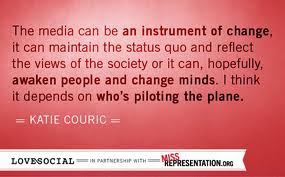
Borrowing from another excellent message distributed today by Miss Representation (www.missrepresentation.org), here’s a reminder to think about change as we celebrate women and girls in all their potential…

toddlers and tiaras

Today is International Women’s Day, so let’s take this collective moment to pledge to end the oppression of women worldwide – in all its forms. Let’s pledge to end not only the overt violence directed at women daily, but the institutional sexism holding us back and the destructive representations of women in the media which contribute to that same culture of negating women and denying them their equal seat at the tables of power. After all, as long as the media hypersexualizes and objectifies women, they normalize treating women as second-class citizens and objects for the male gaze, which further contributes to violence against women.

Katy Couric

We encourage you to spend this special day not only supporting those organizations creating change in the treatment of women globally, but thinking personally about how you can make an impact on the lives of women and girls everywhere. Each of us can play a small part in transforming the way our culture views, values, and treats women and girls.


Child sexual abuse in the news headlines…again

15 02 2013

On the eve of the Family Day long weekend here in Ontario, sexual crimes against children are once again prominent in news headlines. Very prominent. Today’s newscasts are featuring at least four major stories, among them:

  • child pornography charges laid against a Halton teacher
  • an RCMP officer and his wife charged in a shocking child abuse case now unfolding in Ottawa
  • Coronation Street TV star accused of 19 child sexual offences dating from 2001 – 2010
  • Manitoba Court of Appeal lengthens sentence for convicted child sex offender and former hockey coach Graham James (increased from 2 years to 5 years)

BROKEN TRUSTThese cases echo the broken trust that so often surfaces in sexual crimes against children. All instances of sexual abuse are unacceptable, but those committed by adults in positions of trust or authority, including teachers, police officers, coaches, parents, and celebrities, are betrayals of the worst kind. They raise questions not only about those who would perpetrate these worst of assaults against innocence, but also about the failings of society’s efforts to protect vulnerable children.

This Family Day, how about asking what more we can do to value children? If we believe children are indeed the future, and if we recognize that crimes against them ultimately are crimes against tomorrow’s hopes and aspirations, then this seems the right track to changing how children are viewed and treated. If everyone valued children – honoured them and protected them – what would change? Would we find new thinking or effective ideas that could be harnessed in order to nurture these seeds of the future? Could we better understand and address the threats and expose the root causes that have led us to a point in history when the youngest among us face so many dangers? Certainly seems worthwhile asking the questions.

Happy Family Day.


Unthinkable…again

16 12 2012

Sandy Hook ElementaryThe violent loss of so many young children, their teachers, and school psychologist, in Connecticut has us all feeling yet again the impact of another horrible and heartbreaking tragedy. Among the many questions that arise, including “why?”, parents and professionals working with children are asking how best to reassure and support kids in the wake of such violence. The Canadian Association of School Psychologists recommends the resources available from the National Association of School Psychologists (NASP) in the U.S. including information about helping children cope, talking to children about violence, and tips for reinforcing school safety.

Those wanting to access these resources can visit the NASP web site:  http://www.nasponline.org/


Important Choices for Children

10 10 2012

The following commentary, from Stop It Now, is vital reading. It provokes important conversations in the wake of this week’s sentencing of convicted child sex offender Jerry Sandusky and challenges us to recognize the valuable learning opportunities that this case raises. We need more of these discussions, not just during Child Abuse Prevention Month but each and every day. Thanks to Deborah Donovan Rice and her team at Stop It Now for their ongoing work to inspire and inform that dialogue.


October 10, 2012 

Our choices in the wake of Jerry Sandusky’s sentencing  

A Stop It Now! Commentary

Despite his claims of innocence and conspiracy, the prison term handed down yesterday against former Penn State football coach Jerry Sandusky will effectively keep him locked away for the rest of his life. And it puts the rest of us at a collective crossroads in our own lives.

The sentence by Judge Cleland has received a near-universal endorsement from anyone familiar with the sordid details of Sandusky’s sexual abuse of at least 10 boys over a 15-year period. Sandusky was convicted of 45 counts of sexual abuse against the boys, who had come under his influence while he served as a Penn State coach and as the founder of Second Mile, a program for at-risk youth.

 Sandusky’s charitable works, his professions of innocence, and his goofy grin have revealed him to be a complex archetype and an easily-demonized caricature of a predatory sexual manipulator. These two images respectively offer a great opportunity and a significant danger, for educating adults about how to prevent future sexual abuse of children.

 And so, we must choose.

We have an unprecedented opening to use this case’s stunning lessons about ignorance, self-interest and responsibility to closely examine widespread, false assumptions about the dynamics of child sexual abuse and how to prevent it. These assumptions make us all susceptible to becoming silent bystanders who, like many in Sandusky’s midst, fail to protect vulnerable children due to self-protective confusion, fear or misunderstanding.

 Or we can seek reassurance in the caricature and congratulate ourselves for putting away a man who many equate with evil. We can punish the callous individuals and institutions who we believe should have stopped Sandusky. We can consider our duty done. We can convince ourselves that “they” were the problem and “we” would have done better. That’s the danger of this scenario.

Let’s be clear. Almost all adults are convinced they would speak up and intervene if they became aware of a child at risk of being sexually abused. But research and the experience of many survivors of sexual abuse demonstrate that more often than not, adults don’t speak up.

 Why? Because we all want to view people that we know as “good”, and to believe naively that we’ll recognize the “bad” ones.

One of the greatest barriers to preventing childhood sexual abuse is this either/or thinking. This thinking held up Jerry Sandusky as a widely-admired savior of kids, and has now turned him into the bogey man. When any of us has to choose between two extremes of saint or devil, we’re generally reluctant to recategorize someone we respect into the negative category without absolute proof. But research shows that most people who sexually abuse children are complicated individuals with good qualities as well as a horribly destructive problem. They are not solely manipulative monsters.

To stay safe, kids need the adults in their lives to embrace that complex reality.

 Only then do adults realize that it’s possible to start challenging behaviors that confuse children about what’s okay and what isn’t. That’s real prevention.

 Every child needs adults in their life who’ve educated themselves about warning sign behaviors and situations that may indicate an increased risk of abuse. Children need adults who are knowledgeable about healthy sexual development and age appropriate sexual behavior. Children need the adults in their families, programs, schools, and faith communities to speak up – and to follow up.

 Showering alone with a young boy – that’s a warning sign.

 Sharing a bedroom alone on a trip – that’s a warning sign.

 Gifts and favors, special rules, secrets – they’re all warning signs.

 Adults like Penn State coaches, administrators and Second Mile officials didn’t need to determine that Sandusky had bad intentions or an evil personality to take decisive action. They only needed to recognize that he was violating good, interpersonal boundaries. Whatever his intentions, he was setting dangerous precedents. Those are the warning signs that adults can learn to recognize and use to prevent abuse – before it happens.

As satisfying as Sandusky’s long sentence may feel, preventing abuse will always have a much greater positive impact on our children, families and communities, than punishment will after the fact.

 At the end of the day, that’s our choice.

###

Read more at StopItNow.org


October Marks Child Abuse Prevention Month

30 09 2012

Once again this year, October will see efforts across Ontario to raise awareness about child abuse and to remind us that this is a preventable crime. The maltreatment of children, whether by physical, emotional, or sexual abuse, neglect, or subjecting children to the trauma of witnessing violence…whatever the form, child abuse is unacceptable. It’s a sad fact that this message requires repeating, but it does. The incidence of child abuse remains disturbingly high, and new threats are adding to the problem at alarming rates (online predators, the sexualization of childhood, child porn, involvement of minors in the sex trade). Headlines over this past year have once again exposed the vulnerability of children to adult criminal behaviour, and reminded us that many of these children cannot and do not speak up. Those who do stand a shockingly low chance of getting the specialized help they need. Some will never get help.

Statistics show that 1 in 3 girls and 1 in 6 boys will be sexually victimized before reaching age 18. Think about that the next time you drive by a school yard or see a group of children playing in a park.

We can change the statistics. We can do better for children who need our help. Add your voice to the fight against child abuse. Listen to children, and act when they reveal that they have been maltreated – it’s the law. Learn more about this community’s response to child abuse, lend your support, and encourage others to do the same. Wear a purple ribbon to heighten awareness about child abuse. Help eliminate the stigma attached to child abuse by having open conversations about this important issue. Children are counting on us to do that, not just in October but each and every day.

For more information, visit www.childabusecouncil.on.ca