Unacceptable realities…points to ponder

29 08 2014

Something more personal for this post…an update after a considerable hiatus from blogging. I blame Facebook, in part, because of the distraction it provided to this newby. It took several months to discover what I really wanted to get from the site, and how to make my participation meaningful. But it has been my busy professional life that has taken most of my time and attention. Always rewarding, at times frustrating, ever changing, it both commands my full attention while I’m “in it” and necessitates downtime that is just that.

The sexual abuse of children continues to make headlines, along with these same crimes against women. Issues of gender inequality, gender-based violence, exploitation, pornography, cyber bullying, rape culture, sexting, and the debate over the educational curriculum for sexuality and human relations have become so commonplace in news reports that I worry we are numbing to their seriousness. And, on most days, I am hard-pressed to understand how these vitally important issues are not front and centre in our political and public policy discussions. These very issues are the bedrock of my work, each and every day. I notice the headlines, pay attention to the news coverage, am saddened by the disclosures, and outraged by the appalling lack of change. These constant reminders of the work still to be done creep into my off-work hours, make regular appearances in my dreams, and urge me onward. No, I am not obsessed or inappropriately burdened by these unacceptable realities. I manage to keep a healthy (most days) balance. But these remain unacceptable realities.

A friend told me recently that there was a disturbing pattern to many of my posts on Facebook. He said he understood why so many of my posts related to the issues that relate to my professional work, but he “just couldn’t read all of them” and found many of them “too disturbing”. And, sadly, I know he’s not the only one.

So, by way of updating this blog and sharing what has been keeping me busy of late, here are a few points to ponder:

  • today, here in my own community (as in many others), 1 in 3 girls and 1 in 5 boys will be sexually victimized before their 18th birthday
  • in Hamilton, the city I am so proud to live in, overall violent crime has decreased but not sexual crimes against women and children or child pornography
  • the agency I lead, the Community Child Abuse Council, employs the equivalent of 3.2 full-time staff and a team of consulting clinicians who provide direct trauma treatment to children and youth experiencing the trauma that results from sexual abuse – we have a perpetual wait list
  • we also work to address the unique mental health needs of immigrant and refugee children and youth who are experiencing symptoms of trauma – from war-torn countries, experiences in refugee camps, violence, loss, and upheaval – there is a waiting list for this program too
  • we turn every dollar provided by government towards these services into $1.70 – in blunt terms, we spend a significant amount of time and energy raising money to serve the children who need our help, and on any given day the provision of these crucial services may well depend on bake sales and raffles
  • the Council has an incredibly generous circle of supporters with whom I am in regular contact  – their commitment to making sure these essential services are available to youngsters in our community is beyond admirable, yet they are but a tiny proportion of the caring population in Hamilton

children_threatsI share these points not to claim any undue burden or regret – I love the work I am doing and I could not be more committed to this cause. I share these points for consideration by people like my friend who bristled at the content of my posts on Facebook. Or for any readers of this blog who may have wondered why I had been absent of late. I share them because it is important to me that the nature of the Council’s work be understood – an entire community’s response to the sexual abuse of children and youth is resting almost exclusively on the shoulders of one small agency. How fortunate we are to have an exceptionally specialized and seasoned clinical team of experts doing this work. How wonderful it is to know that this agency is accomplishing great things on a daily basis thanks to the tireless efforts of staff who care deeply and volunteers who are passionate. How reassuring to know that the Board of Directors at the Council is comprised of individuals with integrity, careful stewards of public funds, and diligent ambassadors for a cause far too often overshadowed.

Yes, many days I am tired. And I do get frustrated. But I continue to give my all to this remarkable organization and the youngsters it serves because the work we are doing is making a difference. Every day I see the results of treatment programs that are effective. And every day I am fortunate to be around some of the bravest young people you’ll ever meet. They are what matters. Helping them to get beyond the trauma, heal and move forward, that is what counts. We believe thriving children create thriving communities, so everything we do to help our young clients get back on track is ultimately an investment in the future of our community. That inspires me, that commands my attention, and that keeps me focused.

If you find me posting a recipe or a travel link on Facebook, you’ll know it’s been an especially good day.

Postcript:

To date, the most-searched phrase that lands visitors here on my web site is “children girls porn”. Sadly ironic, and another reason for this important work to not only continue but to knock it out of the park. You can help – have a conversation, share resources, point others towards these issues, support the work that is so important to ensuring our youngest community members can go on to be thriving, contributing future leaders.




Happy International Women’s Day!

8 03 2013

Borrowing from another excellent message distributed today by Miss Representation (www.missrepresentation.org), here’s a reminder to think about change as we celebrate women and girls in all their potential…

toddlers and tiaras

Today is International Women’s Day, so let’s take this collective moment to pledge to end the oppression of women worldwide – in all its forms. Let’s pledge to end not only the overt violence directed at women daily, but the institutional sexism holding us back and the destructive representations of women in the media which contribute to that same culture of negating women and denying them their equal seat at the tables of power. After all, as long as the media hypersexualizes and objectifies women, they normalize treating women as second-class citizens and objects for the male gaze, which further contributes to violence against women.

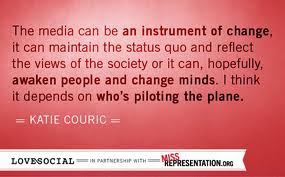
Katy Couric

We encourage you to spend this special day not only supporting those organizations creating change in the treatment of women globally, but thinking personally about how you can make an impact on the lives of women and girls everywhere. Each of us can play a small part in transforming the way our culture views, values, and treats women and girls.


This Valentine’s Day, spread the love and spread the word

8 02 2013

www.missrepresentation.orgLast Sunday, during the biggest media event of the year, supporters of Miss Representation came together to put sexism in advertising in the spotlight and make it a topic of conversation. As a result, over 4 million people heard or saw their critiques of Super Bowl commercials and their message was picked up by numerous major news outlets, including CNN and National Public Radio (NPR). As a result, countless thousands have been inspired to be more aware of the representations of gender they consume daily. That’s what I love about Miss Representation – they’re continually bringing solid information to new audiences what are then able to decide for themselves about the values that are important to them.

Go Daddy alone received more than 7,500 tweets in just 5 hours concerning their stereotypical and demeaning Super Bowl ad. This was accomplished by thousands of individuals deciding to take a break from watching the big game to use their consumer voice to let advertisers know: when it comes to using sexism to sell, we’re #NotBuyingIt! (that’s the Miss Representation campaign, by the way).

And it works. After Teleflora’s highly offensive and degrading Super Bowl commercial, which implied that women would exchange sex with any man who could afford a few flowers, hundreds of folks took to Twitter to express their dismay and disgust. In a show of the increasing ability of social media to create real change, Harrod’s in London removed two children’s books from their children’s reading room after users on Twitter, with the help of the #NotBuyingIt hashtag, let the store know that the items promoted gender stereotypes.

Next Thursday, on Valentine’s Day, Miss Representation is helping to coordinate another effort aimed at showing what we’re capable of when we band together under a common cause. On February 14th, Eve Ensler’s V-Day organization is organizing one billion women, and those who love them, to rise up and demand an end to violence against women.obr_logo-web

“Today, on the planet, a billion women – one of every three women on the planet – will be raped or beaten in her lifetime. That’s ONE BILLION mothers, daughters, sisters, partners, and friends violated. V-Day REFUSES to stand by as more than a billion women experience violence.”

The worldwide event, One Billion Rising, is being held in cities and towns across the globe, and will feature performances, dances and women speaking out against violence in unity. To find out more, go to http://www.onebillionrising.org – and if you haven’t already become familiar with Miss Representation, visit their site at http://www.missrepresentation.org.

The Valentine’s Day, spread the love and spread the word – 1 billion women violated is an atrocity. 1 billion women dancing is a revolution.


International Women’s Day

8 03 2012

Regrettably, I haven’t been blogging much of late…a full plate has kept me busily occupied (and quite content) but finding time to blog has been a challenge. Today, however, I had to share a wonderful link to inspire and to acknowledge, to support and to inform…

http://www.youtube.com/watch?feature=player_embedded&v=KQOVUK68mTg

We’ve come a long way since the first IWD, but there is still much to do. I am ever-more convinced of this and acutely aware of the remaining challenges with each day spent working with the brave youngsters, dedicated staff, and generous supporters at the Community Child Abuse Council. To be clear, violence against women or children is not “a women’s issue”. It will, however, take our collective voices at full volume to change the unacceptable reality that 1 in 3 girls (and 1 in 5 boys) will be sexually victimized before adulthood.

Thanks Ayesha, for reminding us to shake the tree.


1 in 3 Women

4 04 2011

Ontario’s new Sexual Violence Action Plan: Changing Attitudes, Changing Lives addresses a “serious and pervasive” problem in this province. It speaks frankly (“violence against women devastates lives – it has no place in society and it will not be tolerated”) and includes a commitment of $15 million over four years ($5.2 M for public education campaigns, $1.6 M for professional training and education, $3 M for sexual assault centres, $3.7 M for interpreter services, $1.95 M for anti-human trafficking initiatives). 

Many Ontarians don’t realize the alarming statistics surrounding sexual violence and its prevalence in the lives of far too many women. One in three women will experience some form of sexual assault in their lifetime. Sexual violence crosses all social boundaries, affects women of every age and cultural background, and has devastating impacts on the lives of victims and their families as well as the well-being of society as a whole. [Laurel Broten, Minister Responsible for Women’s Issues, Sexual Violence Action Plan, March 2011].

The plan updates the Province’s former “domestic violence” action plan (2004) and addresses crimes such as sexual assault, sexual exploitation through human trafficking, sexual harassment, and sexual exploitation using technology and the Internet. It focuses on sexual violence against those 16 years of age and older (the Plan reports that separate initiatives are being developed for children and for men).

Many people only think of sexual violence as a very violent crime that happens between strangers – the perpetrator lurking in a dark alley or in the bushes. In reality, most sexual assaults are committed by someone known to the victim – an acquaintance, date, friend, colleague or family member – and often it occurs in private places, like the victim’s home [Ontario’s Sexual Violence Action Plan].

The Plan acknowledges that current statistics are alarming and that women across Ontario live in fear. The crime that is sexual violence won’t be curtailed successfully by any one effort or approach alone, thus it is heartening to see prevention as well as post-incident response included in the Province’s approach. The stated vision in the Plan is that “Ontario is a place where all women live in safety, and are free from the threat, fear or experience of sexual violence”. Published progress reports are promised after two and four-year intervals (2013 and 2015).

No less than 16 provincial Ministries are listed in the Plan as partners in the effort and members of the Ministerial Steering Committee on Violence Against Women, and the Plan highlights several collaborative approaches. It is nonetheless unfortunate that the leadership in launching this Plan came from the Minister Responsible for Women’s Issues. Sexual violence is not a “women’s issue”. But the Plan does include a request from the Province for changes to the Criminal Code of Canada and that’s a positive step in the battle against electronic victimization (among the newest threats). Also welcomed is the Province’s financial investment in education, prevention and victim response initiatives.

For a full version of the 23-page Plan click here: Ontario’s Sexual Violence Action Plan 2011.


Hamilton needs more than policing to end violence

12 12 2010

Hamilton’s new Mayor, Bob Bratina, has praised recent efforts by Hamilton Police Service (and particularly the ACTION unit) at reducing crime in the downtown core. The Dundas News reports that between May and November of this year, the special ACTION unit’s 40 officers made 657 arrests, laid 960 charges, seized more than $400,000 in illegal street drugs and issued 3,250 offense tickets. Muggings were down, as were life-threatening calls.

(photo: thehamiltonian.net)

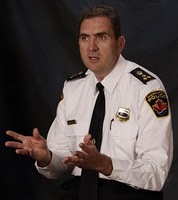
Police Chief, Glenn De Caire, told a recent press conference that he expects to see the crime rate go up as reporting and enforcement efforts continue, but that this translates into increased safety. This is good news for our troubled downtown core, and a commendable accomplishment for our police service. Mayor Bratina has pointed to unruliness, loitering, yelling and public disorder as embarrassing indicators of the downtown’s problem areas (especially the intersection of James and King Sts.). But he and Council will need to look much further and extend their reach considerably if they are genuinely committed to reducing violence in this community.

The focus on downtown, aside from being Mayor Bratina’s ward, has much to do with exposure. It’s part of the city that is on display to all who pass through, and its shady reputation is an oft-cited reason for shopping elsewhere. Those who have worked in the core know that it is an eye-opening sight on any typical day. And yes, there are incidents involving violence. But the bigger picture has yet to be addressed by our elected leaders.

Violence against women, child abuse and sexual exploitation, and elder abuse are (to our shame) alive and well here in Hamilton. These are significant concerns as well as repugnant crimes. No community can claim to be making ground in anti-violence efforts while these horrific crimes continue. It matters not that the “jurisdiction” for addressing these crimes does not rest solely at the municipal level. Our city’s leaders must be the loudest voices among those demanding resources and action from all levels of government. It matters not that rates decline or rise from one year to the next – a sexually abused 3-year old is never an acceptable statistic.

What does matter is that we see these violent crimes as a community-wide issue. Our tolerance for abuse must be zero, and our collective response to the victimization of our citizens must be loud and clear – we  expect the prevention of violence to be a priority in all City actions. That will help to turn attention to the root causes behind some of these crimes, and to the lobbying

Mayor Bratina (photo: Spectator)

and advocacy efforts that are required of our city leaders in order to address those causes. In the same way that we are acting to eliminate poverty in Hamilton, we must act to eliminate violence. The police will be crucial partners in these efforts, but we can’t reasonably expect them to prevent violence on their own.

MPP Sophia Aggelonitis has expressed her concern about these issues in the past, and recently cited the provincial government’s commitment of more than $1 million to Hamilton as part of her government’s anti-violence strategy. We should expect to see part of this money earmarked for violence prevention that goes beyond policing to address the victimization of children, seniors, and women as well as prevention of violent crime in general. Sure, we’d like to see fewer fights in front of Jackson Square. But tidying up the unsightly facade downtown won’t do much in making Hamilton the best place in which to raise a child. In truth, much of the violence in this community is hidden and too rarely spoken about. Elder abuse doesn’t tend to happen on busy streets downtown, nor does child pornography appear in public places very often. These crimes happen in the shadows. They happen in homes. They happen in all parts of Hamilton. And each time they do, the victims are our neighbours, our family members, our friends. These are ugly crimes that leave lasting scars. Preventing them must be high on our new City Council’s agenda.


Old Spice?

9 11 2010

Marketing magazine recently reported that Canadians are fans of the current Old Spice advertising campaign (“You like the way I look. Of course you do.”). Not only was it the most recognized campaign, it was also the best liked in this country (least liked? The family chasing the Dairy Queen Blizzard truck).

Flash back for a moment to 1965 and imagine the likelihood of either of these marketing campaigns being successful. A naked guy taunting us from the shower? A family drive with Mom on the hood of the car trying to grab hold of an ice cream truck? Doubtful these would ever have been conceived, let alone aired and memorable. My point here is that things have changed considerably in the way marketing reaches us. More disturbing to me is the change in how it affects us, and what has become acceptable to so many of us.

The so-called “prime time” viewing slots on television have opened up to include programming that once was restricted to much later hours and intended for adults only. Shows like “Pimp My Ride” and “Desperate Housewives” are now airing when young kids are still in their living rooms. Not that long ago, Brooke Shields caused a tremendous uproar by exposing her navel and midrift in an advertising campaign. Bratz dolls have sexed up their wardrobes to the point that once-fashionable Barbie has now donned similar garb in order to stay “trendy” and competitive. The cast of Glee on the cover of GQ magazine has been in the news for its racy portrayal of highschool kids, and children have come to know firefighters in most communities as heroes and calendar pinups.

There’s only one common element in all this, and it’s money. Whatever sells goes. And we buy it. Every lowdown, inappropriate and disrespectful moment of it. Maybe our filters are so tired from trying to screen and distinguish among all this stuff that they just don’t work anymore. Or maybe we’ve just become numb to all the skin and sex and selling. Old Spice sales reportedly are up, and Bratz dolls are again being touted as a must-have item for the holidays this year. Trouble is, child abuse is up too. Domestic assaults are still a plague on families. Pornography still nets kids and ruins lives. The links are obvious. What we do about it is trickier.

Stop advertising? No. Censor more of this stuff? Governments won’t do it. Quit spending our money on the products and services that try to sell to kids with sex and violence? Now that just might work. I spoke to a mother the other day who had been trying to explain to her 8-year old why a particular mannequin’s outfit was inappropriate for school (mini skirt, lacy tights, spaghetti strap/sequin top). It’s not easy. I admire her taking a stand though, and she showed that it can be done (and done at any age) with patience and love. She told me she’d rather put up with a few tantrums than risk the alternative.

Can we find more ways to reinforce the appropriate, and gradually reduce the inappropriate, from our lives and the lives of young children? Can we do a better job of turning trashy TV into teachable moments for kids? I think so. And I tip my hat to all those parents out there who are trying to do just that every day. Their task is daunting, and they could use our help and reinforcement. Whether you have children or not, take opportunities to voice your disapproval when the merchandise in the next store you visit falls well short of the mark for appropriateness. As I often hear teachers and parents telling children, “use your voice”.

Photo: spreadshirt.com


Changing our Sexually Toxic Environment

2 11 2010

Cordelia Anderson

If you read this blog regularly, you know that Cordelia Anderson recently spoke about our “sexually toxic environment” as part of a discussion here in Hamilton during Child Abuse Prevention Month (October). Her insights and revelations about “porn culture” and what we must do to reverse the hijacking of our sexuality fired up those who were fortunate enough to be present – and I hope that lasts! In the meantime, I took to heart Cordelia’s message about doing what we can, in our own circles of influence, to rid ourselves of the overly sexual (“hypersexualized”) danger zone in which we (and youngsters) live.

While traveling, I now request a “porn free” room when I make hotel reservations. This means insisting on a room that doesn’t have pay-per-view pornography or has blocked the availability of it during my stay. Families as well as individuals can do this easily…and the more who do, the more likely we are to find greater availability of these rooms.

While shopping, I no longer turn away and ignore inappropriate or offensive merchandise. I recently pointed out to a shopkeeper that a particularly sexual t-shirt had no place on display in a store selling children’s clothing. In another, I complained about a line of merchandise called “Porn for Women” that was prominently displayed in the gift shop of a heritage site (go figure). In both cases, I elected to shop elsewhere and let them know why this was my decision.

These individual efforts do pay off. After complaining about a rubber tag for sale in a local dollar store (“On Myspace I’m Legal”) – displayed next to Dora The Explorer and other kids’ items – the store not only removed it from their inventory but also invited me to write to their head office and explain why it’s unacceptable. Pointing out the inappropriateness of sexualized merchandise can lead to an “aha” moment for sales clerks, store managers, buyers and distributors. Community-minded corporations will often respond when made aware of merchandise that might otherwise have slipped through their radar.

There are a host of things we can do, each of us, to change our environment so that these hypersexualized examples are not considered “normal”. First and foremost, remember that money talks. Spend it strategically. If you don’t think dolls for young girls should be dressed in feather boas and miniskirts, don’t buy them. And let store staff know why you won’t spend your money on these items. If you don’t think the lyrics to certain songs are healthy for the sexuality of our young people, point that out to them. Explain what’s degrading or objectifying about the words, and offer empowering messages instead.

Simply starting a conversation can be enough to get the ball rolling. How do you feel about the mainstream TV line-up including shows like “Pimp My Ride”? What about the results you get when you search for “porn” on Google? For an interesting comparison, Cordelia Anderson suggests trying that search and then searching for “healthy sexuality” and seeing the difference in results (and the time it takes).

October was Child Abuse Prevention Month. November is the month set aside to talk about woman abuse and to raise awareness about the problem. If we only address these issues once a year, we can pretty much give up on making any inroads. If we continue to let media and merchandisers degrade and objectify women, we won’t get very far either. So speak up, engage others, and spend strategically. It will take all of us to make a difference in what “normal” consists of and whether messages about healthy sexuality are available to young people.

“The need for change bulldozed road down the center of my mind”.

Maya Angelou


Canada’s Gender Gap

1 11 2010

November is Woman Abuse Awareness Month, and that has brought a substantial amount of research across my desk that is released or publicized in conjunction with events and activities designed to mark the month and support awareness and advocacy efforts. One of these research reports caught my attention in a big way.

The World Economic Forum has been publishing the Global Gender Gap report since 2006. It tracks national gender gaps in economics, politics, education and health, and ranks countries according to these criteria. This allows for comparisons across regions and income groups, and over time.

Every year since its inception in 2006 , the report has ranked Iceland, Norway, and Sweden in the top spots (Finland made it to #3 this year). The forerunner to this report, Women’s Empowerment: Measuring the Global Gender Gap (published in 2005), ranked Canada in 7th spot. Since then, however, we have fallen significantly in the rankings.

2006 -14th
2007 -18th
2008 – 31st
2009 – 25th
2010 – 20th

The United States (19th this year) closed its gender gap, rising 12 places to enter the top 20 for the first time in the report’s five-year history. Our current federal government took power in 2006 and has obviously not made this a priority. When the subindexes are scrutinized, we find that Canada ranks 10th for women’s economic participation and opportunity, but 60th for health and survival, and 62nd for political empowerment. We are ranked 38th for women’s educational attainment.

Melanne Verveer, US Ambassador-at-Large for Global Women’s Issues, points out that the report “shows a strong correlation between gender equality and a country’s prosperity and economic competitiveness.”

This month, as we contemplate the continued existence of woman abuse in 21st Century Canada, we might also reflect on the missing values that are reflected in Canada’s poor performance in shrinking the gender gap – if women and their contributions to Canadian life are indeed valued, this certainly isn’t mirrored in our ranking or in our failure to end the abuse of women. Like child abuse, we won’t be able to solve this problem with education alone, or prosecution alone, or treatment alone…we’ll need all of these things, and more.

My thanks to Krista at the Sexual Assault Centre (Hamilton & Area) for sharing the global report. For more information, go to www.weforum.org

or find the report at http://www.weforum.org/en/Communities/Women%20Leaders%20and%20Gender%20Parity/GenderGapNetwork/index.htm


Take Back The Night

14 09 2010

A woman walks alone down a dark, deserted street. With every shadow she sees, and every sound she hears, her pounding heart flutters and skips a beat. She hurries her pace as she sees her destination become closer. She is almost there. She reaches the front door, goes inside, collects herself, and moves on forgetting, at least for tonight, the gripping fear that momentarily enveloped her life.

This scene, quoted from the Take Back The Night foundation’s web site, might have unfolded in any city. The fear associated with walking at night, for many women, is the reason Take Back The Night events happen all over the world. What started as a candlelit march in Philadelphia in 1975 has become a symbolic show of unity and purpose held annually in cities everywhere (Canada’s first was in Vancouver, 1978). Marches  take place in September in most Canadian cities. In Hamilton, this year’s march will be on Thursday, September 16th – City Hall, 6:30 pm gathering, 7:30 pm rally, 8:00 pm march.

 Women from New York to India are letting their voices shatter the silence, but there is much to be accomplished in the fight to end sexual violence. Crimes of this nature continue to appear in the news in epidemic proportions. Our movies, our music, and daily news describe another killing, shooting; more abuse, violence and rape. As the history of Take Back the Night continues to be written, its mission to end sexual violence for all remains a beacon of hope for the millions affected by crimes of violence. We have made great strides, but our march is far from over. [Take Back The Night foundation web site]

In keeping with the symbolic gesture of women “taking back the night”, organizers of Hamilton’s march (like the majority) do not open the event to male participants. A separate gathering, with speaker and discussion, is hosted so that men may be allies in the cause and show their support without actually marching (6:30 pm, Skydragon, 75 King William St.).

For more information about the Hamilton event, visit the Sexual Assault Centre (Hamilton and Area) web site: www.sacha.ca. Information about the history of these events and their purpose around the world can be found on the TBTN foundation web site: www.takebackthenight.org.