Thinking outside the lunchbox

2 02 2011

I recently had the opportunity to facilitate a discussion among stakeholders from education, health, social services, municipal services, business, food and nutrition, and philanthropic interests. The topic was the development of a school-based, universal student nutrition program for Hamilton. I have been working with the Hamilton Community Foundation on this project for several months, and this discussion was the latest step in the Foundation’s effort at helping the community to move forward with the goal that “no child leaves school hungry”.

This was a dynamic group discussion, and one peppered with as many questions as answers. That’s par for the course at this early juncture in a community initiative. But despite the unknowns, local stakeholders in attendance made it clear that they see this project as not only important but also entirely necessary. Too many youngsters don’t receive adequate nutrition in Hamilton, and many are hungry enough to be distracted from learning. But what to do? Stakeholders at the session were asked how they would approach the development of a program to make sure all students get enough to eat. They were encouraged to think beyond current efforts, such as traditional school programs or breakfast clubs. They were asked to push themselves to think “from scratch” and not be limited by the way things have historically been done. Their level of enthusiasm and commitment is a good sign of support for seeing this preliminary work by the Foundation turn into something tangible. It’s premature to report anything here in terms of the discussion, but I was reassured by the focus on outcomes for children, the desire to see parents engaged and involved, and the willingness for most stakeholders to step outside their usual parameters just long enough to imagine something new and different.

Watch for developments in the School Nutrition Project as the discussion progresses and early ideas take shape. Think you’d like to be part of the discussion? Please contact me.



Talking About Mental Health

28 01 2011

Clara Hughes

You may have seen Canadian Olympian Clara Hughes on television recently promoting Bell’s “Let’s Talk Day” (February 9th). To find out more about this day in support of mental health, check this site:

http://letstalk.bell.ca/?INT=CORP_BAN_bellhmpg_bltd_011711_LM_en

The campaign is described as one aimed at raising awareness and encouraging dialogue about mental health. It is reported that 1 in 5 Canadians will experience some form of mental illness during their lifetime. It’s an important conversation. Hughes has offered up her own personal experiences as one of those affected by mental illness in order to strengthen the dialogue. The site includes a video with her story.

Also of interest, the Canadian Journal of Mental Health has published a special issue devoted to the recent Service Enhancement Evaluation Initiative (SEEI). It details four years of evaluation inside Ontario’s mental health system and specifically the impact of more than $160 million invested by the province. Dr. Lindsey George, Mental Health Program Director at the Hamilton Family Health Team, was one of the principal investigators and is a guest editor for this special issue.

To access the issue follow this link: http://www.metapress.com/content/t3487j06486q/?p=f751c446a3384cb29116b024e1f61f34&pi=1.


New Issue of Leadership Briefing

16 12 2010

The most recent issue of the Community Child Abuse Council’s Leadership Briefing is now available. To view a copy, visit their web site www.childabusecouncil.on.ca.

These briefings are produced regularly by Karen Smith for the Council and include research, updates and happenings related to the Council, child abuse in general, and child sexual maltreatment in particular. To be added to the mailing list for future issues (electronic only) email me or the Council.


Canada’s Gender Gap

1 11 2010

November is Woman Abuse Awareness Month, and that has brought a substantial amount of research across my desk that is released or publicized in conjunction with events and activities designed to mark the month and support awareness and advocacy efforts. One of these research reports caught my attention in a big way.

The World Economic Forum has been publishing the Global Gender Gap report since 2006. It tracks national gender gaps in economics, politics, education and health, and ranks countries according to these criteria. This allows for comparisons across regions and income groups, and over time.

Every year since its inception in 2006 , the report has ranked Iceland, Norway, and Sweden in the top spots (Finland made it to #3 this year). The forerunner to this report, Women’s Empowerment: Measuring the Global Gender Gap (published in 2005), ranked Canada in 7th spot. Since then, however, we have fallen significantly in the rankings.

2006 -14th
2007 -18th
2008 – 31st
2009 – 25th
2010 – 20th

The United States (19th this year) closed its gender gap, rising 12 places to enter the top 20 for the first time in the report’s five-year history. Our current federal government took power in 2006 and has obviously not made this a priority. When the subindexes are scrutinized, we find that Canada ranks 10th for women’s economic participation and opportunity, but 60th for health and survival, and 62nd for political empowerment. We are ranked 38th for women’s educational attainment.

Melanne Verveer, US Ambassador-at-Large for Global Women’s Issues, points out that the report “shows a strong correlation between gender equality and a country’s prosperity and economic competitiveness.”

This month, as we contemplate the continued existence of woman abuse in 21st Century Canada, we might also reflect on the missing values that are reflected in Canada’s poor performance in shrinking the gender gap – if women and their contributions to Canadian life are indeed valued, this certainly isn’t mirrored in our ranking or in our failure to end the abuse of women. Like child abuse, we won’t be able to solve this problem with education alone, or prosecution alone, or treatment alone…we’ll need all of these things, and more.

My thanks to Krista at the Sexual Assault Centre (Hamilton & Area) for sharing the global report. For more information, go to www.weforum.org

or find the report at http://www.weforum.org/en/Communities/Women%20Leaders%20and%20Gender%20Parity/GenderGapNetwork/index.htm


From Dr. Seuss to Porn

20 10 2010

Parent Evening

The Community Child Abuse Council of Canada presents a special evening for parents on Monday, October 25 as part of its Child Abuse Prevention Month activities. The free evening event features Cordelia Anderson, a recognized expert in child maltreatment. Anderson will engage parents, caregivers and foster parents in a dialogue about what she calls our “sexually toxic” society and how to help children navigate this potentially dangerous landscape.

Pre-registration is required: call (905) 523-1020 ext. 14 or visit the Council’s web site: www.childabusecouncil.on.ca for more information.

On Tuesday, October 26 Cordelia Anderson will be the featured speaker at an all-day symposium for professionals. The focus of the day includes the sexual development of children and the impact of today’s cultural norms and sexually permissive media. For full information visit www.childabusecouncil.on.ca or call the Council: (905) 523-1020 ext. 14. Registration fee is $75.00 per person and space is limited.


World Food Day

16 10 2010

October 16 is World Food Day. This year, the theme of the day is “united against hunger”.

We are fortunate in Canada to be among the world’s healthiest populations and producers of significant amounts of food. From grains to fish, our ability to draw from the land and waters is abundant. Still, we have our own problems with hunger. Many find this surprising, but we nonetheless have a sizeable number of people in this country who do not get adequate food on a regular basis. Food banks, hot meal programs, community gardens, and various public health and community initiatives are aimed at this food insecurity problem. Here in Hamilton, local farmers and concerned donors have joined in the battle against hunger. Hamilton Food Share was out in those fields today, receiving freshly-harvested carrots destined for food banks in the coming days. Increasing the amount of fresh food available to food bank users is just one of the challenges facing local service providers.

In coming weeks Karen will be working with the Hamilton Community Foundation to support a community initiative aimed at bringing enhanced nutrition and food intake to local schools. Hunger hits children particularly hard, negatively affecting their development and learning. More than 8,000 children use local food banks despite breakfast programs and school nutrition initiatives. Watch for future updates about the local food insecurity landscape and the Hamilton Community Foundation initiative.

Of interest, the UN’s Food and Agriculture Organization has a world hunger map indicating levels of food insecurity and hunger around the globe. With the exception of Australia and New Zealand, the current map shows the entire southern hemisphere as being hungry to varying degrees. North of the equator, parts of Central America, Mexico, the Caribbean, China, the Middle East and Southeast Asia are indicated on the map as experiencing some level of hunger but nowhere in North America, Europe, Scandinavia, Japan, or the rest of Asia.

For more information, visit www.fao.org.

To support local food banks, go to: www.hamiltonfoodshare.org. Every $1 in donations raises $5 in food. To support the Hamilton Community Foundation, go to: www.hcf.on.ca.

You can add your name to the worldwide anti-hunger petition by going to: www.1billionhungry.org.


Vital Signs

12 10 2010

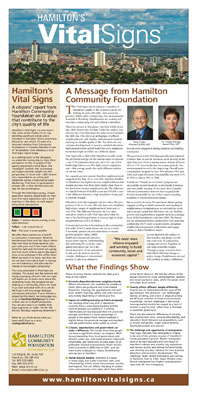
The 2010 Hamilton’s Vital Signs report paints a picture of Hamilton that is described by the Hamilton Community Foundation as “two cities that share the same urban boundary but little else. One city is an archipelago of affluent neighbourhoods with healthy, well-educated residents enjoying an enviable quality of life. The other city concentrates shocking levels of poverty, curtailed education, high unemployment and ill health into poor neighbourhoods that might as well be on a different planet”.

The Foundation calls on us for compassion, outrage and action in response to neighbourhood disparities, poor voter turnout, the need for a “living wage”, growing domestic violence, and child poverty (among other identified trends and issues).

This is required reading for anyone with an interest in bettering the community, predicting future prospects, or engaging more actively in civic life (there’s a great list of things you can do to help). As a city, we’ve come a long way. But as a community emboldened for the future we have considerable work still to do.


Hot Off the Press: Leadership Briefing from the Community Child Abuse Council of Canada

25 09 2010

EnMark Associates is pleased to share the latest issue of the Community Child Abuse Council of Canada’s ongoing series of leadership briefings. This issue features research and information about online safety for children, Internet use by young people, and resources for youth.

Leadership 8

If you would like to receive these briefings on a regular basis, please contact the Community Child Abuse Council of Canada and ask to be added to their electronic mailing list. Back issues are available on their web site:

www.childabusecouncil.on.ca


On the road for Connections…

15 09 2010

Karen will be facilitating four regional sessions for Connections this month, beginning in St. John’s on September 17th. These sessions will bring together service providers and policymakers for a full day of knowledge exchange about women with substance use issues. Results from Connections’ recent meta-analysis will be shared with participants, who will then inform knowledge exchange planning and strategies to be pursued by researchers during the next phase of Connections’ work. The goal of Connections research is to improve services for women with substance use issues and their children in Canada.  

Scheduled sessions: 

  • Friday, September 17 – St. John’s, Newfoundland
  • Thursday, September 23 – Vancouver, BC
  • Friday, September 24 – Saskatoon, Saskatchewan
  • Friday, October 1 – Ottawa, Ontario

The Canadian Institute of Health Research (CIHR) provided $1.4 million in funding over 5 years for Connections research. The objective is to identify the research needs of nearly 800 agencies working with women who have substance use issues across Canada, and to then develop, implement and evaluate knowledge translation and exchange strategies.  

Connections spokesperson, Alison Niccols, says “findings will help improve services, reduce costs (in terms of crime, unemployment, neonatal intensive care, etc.), and ultimately improve the health of a vulnerable, marginalized population of women and children at high risk for poor outcomes”. The research is timely, she points out, given that substance abuse during pregnancy has been identified as a major public health concern. At least 24,000 Canadians under the age of 21 have Fetal Alcohol Spectrum Disorder and the annual cost to Canadians is more than $344 million according to Connections. 


Maternal use of alcohol and other drugs can have profound effects on child health and development. Many women who continue to abuse substances after childbirth have challenging life circumstances, including lack of affordable housing, diminished capacity for parenting, and difficulties providing stable, nurturing environments for their children. 


Led by researchers from McMaster University and McMaster Children’s Hospital, the Connections project involves collaboration among researchers from the Centre for Addiction and Mental Health, the University of Toronto, the University of Western Ontario, and the University of British Columbia.   

For more information: www.connectionscanada.ca 


Connections – if you work with women who have substance abuse issues…

5 09 2010

I will be facilitating four regional networking sessions across Canada later this month for Connections, a knowledge exchange network for agencies serving women with substance abuse issues.

The goal of Connections research is to improve services for women with substance use issues and their children in Canada. Children born to women who used substances during pregnancy are at greater risk for health and developmental problems. Women who continue to use substances after childbirth may have diminished capacity for parenting and have their own social and health problems” (from the Connections web site).

If you work in the substance abuse field, and particularly with women, check out the Connections web site and watch for us in St. John’s, Ottawa, Saskatoon and Vancouver.

www.connectionscanada.ca